Hyperparameters and lags search: backtesting vs one-step-ahead
Hyperparameter and lag tuning involves systematically testing different values or combinations of hyperparameters (and/or lags) to find the optimal configuration that gives the best performance. The skforecast library provides two different methods to evaluate each candidate configuration:
Backtesting: In this method, the model predicts several steps ahead in each iteration, using the same forecast horizon and retraining frequency strategy that would be used if the model were deployed. This simulates a real forecasting scenario where the model is retrained and updated over time. More information here.
One-Step Ahead: Evaluates the model using only one-step-ahead predictions. This method is faster because it requires fewer iterations, but it only tests the model's performance in the immediate next time step ().
Each method uses a different evaluation strategy, so they may produce different results. However, in the long run, both methods are expected to converge to similar selections of optimal hyperparameters. The one-step-ahead method is much faster than backtesting because it requires fewer iterations, but it only tests the model's performance in the immediate next time step. It is recommended to backtest the final model for a more accurate multi-step performance estimate.
The document compares the performance of these two methods when applied to various datasets and forecaster types. The process is outlined as follows:
Optimal hyperparameters and lags are identified through a search using both backtesting and one-step-ahead evaluation methods. This search is performed on the validation partition, and the best configuration is stored along with the time taken to complete the search.
Finally, the selected best configuration is evaluated on the test partition using a backtesting procedure.
It is important to note that the final evaluation is consistently performed using backtesting to simulate a real-world multi-step forecasting scenario.
Results
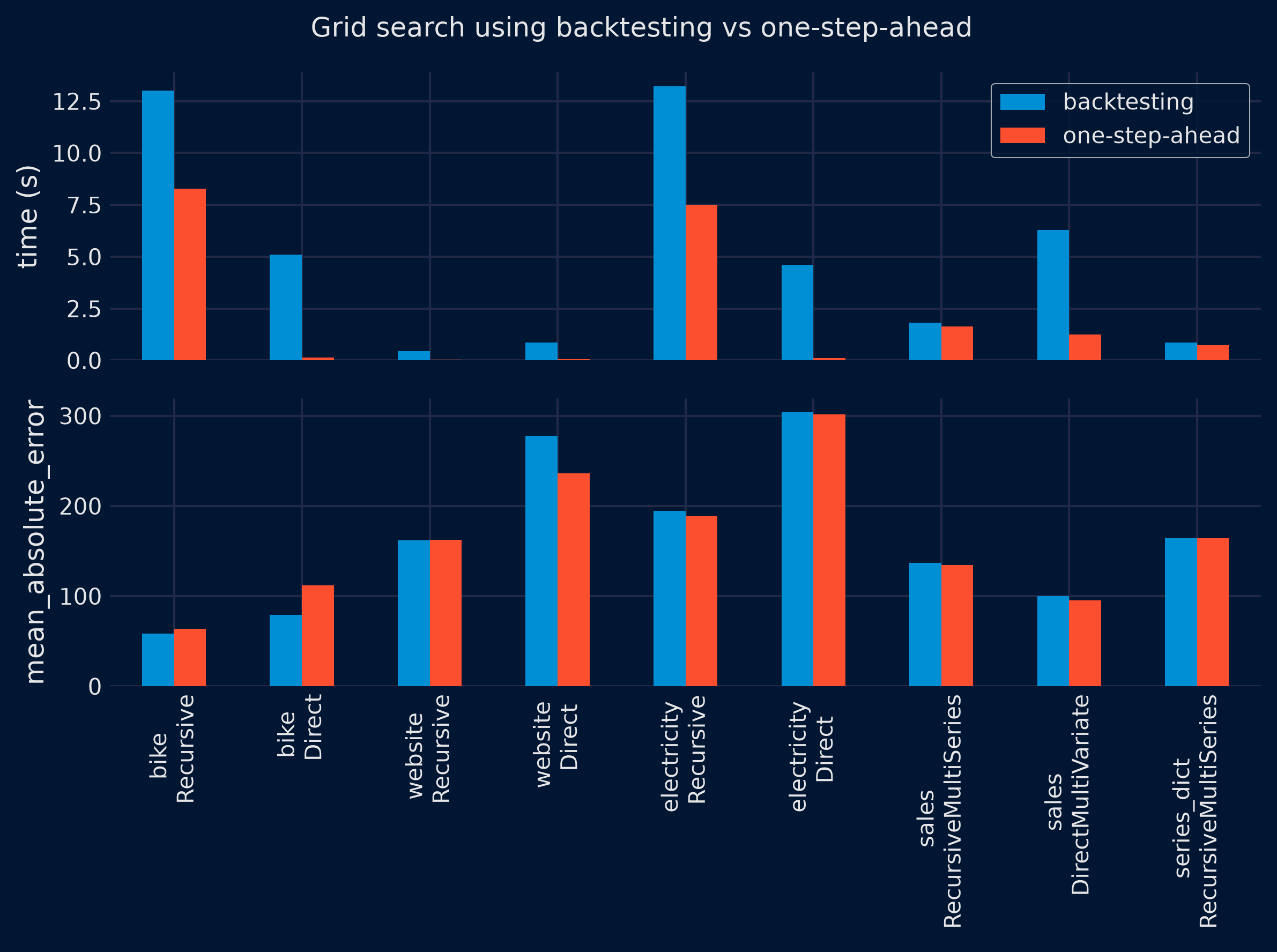
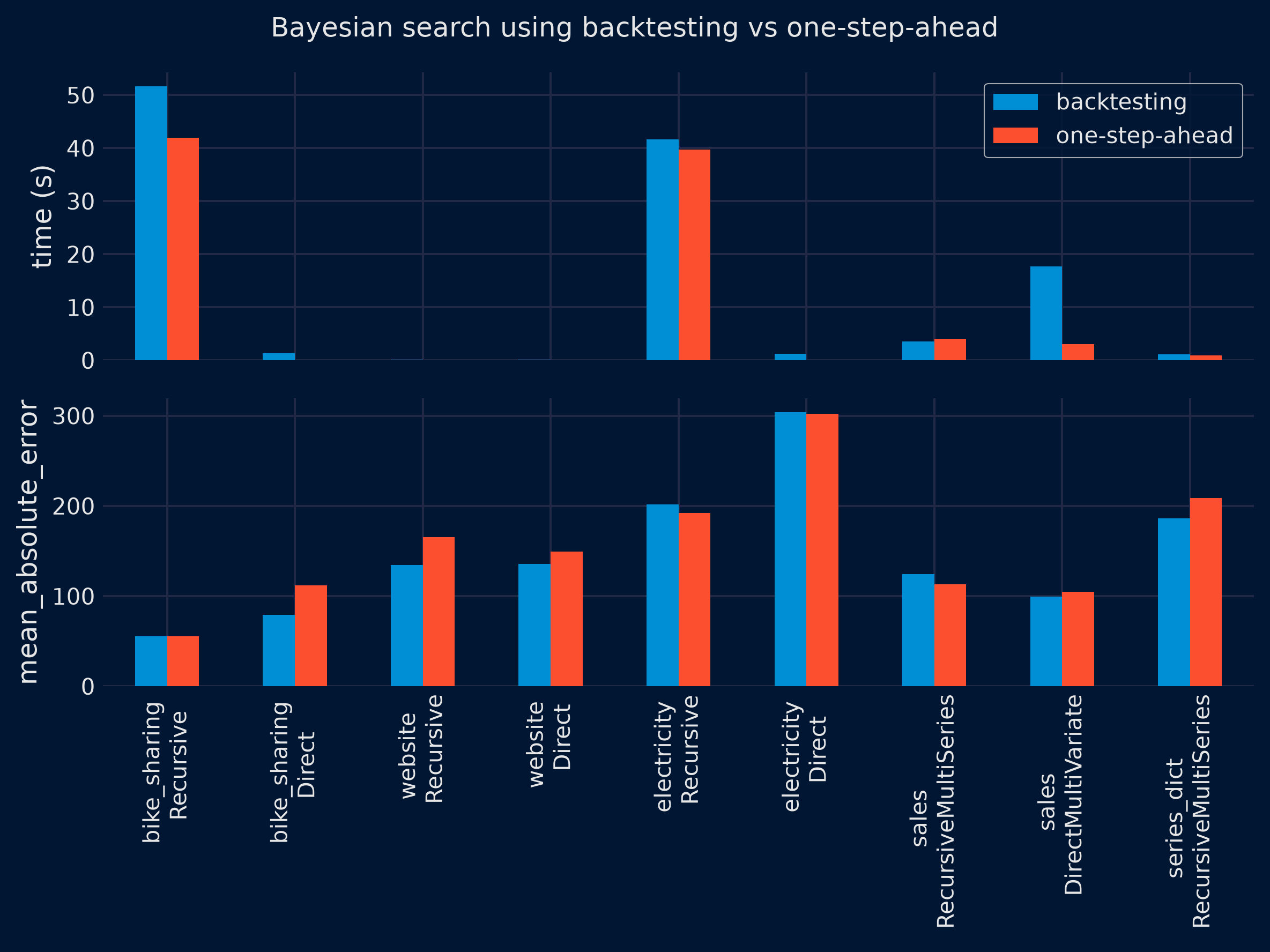
The one-step-ahead method reduces the time of the search in almost every case (top panel): between 5 and 43 times with the direct forecasters and, in most cases, up to 1.8 times with the recursive ones. The performance of the selected configuration on the test partition is similar in most cases (lower panel). When the two methods differ, neither is consistently better, but the largest differences (up to 29%) favor the configuration selected with backtesting. The pattern is the same for grid search and Bayesian search.
✏️ Note
The purpose of this analysis is to compare the time and forecasting performance of the two available evaluation methods, not to compare different forecasters.
Libraries and data
# Libraries
# ==============================================================================
import platform
import psutil
import numpy as np
import pandas as pd
import matplotlib.pyplot as plt
from time import time
from copy import copy
import sklearn
import skforecast
import lightgbm
from lightgbm import LGBMRegressor
from sklearn.linear_model import Ridge
from sklearn.preprocessing import StandardScaler
from skforecast.datasets import fetch_dataset
from skforecast.plot import set_dark_theme
from skforecast.recursive import ForecasterRecursive
from skforecast.direct import ForecasterDirect
from skforecast.model_selection import TimeSeriesFold, OneStepAheadFold
from skforecast.model_selection import grid_search_forecaster
from skforecast.model_selection import bayesian_search_forecaster
from skforecast.model_selection import backtesting_forecaster
from skforecast.recursive import ForecasterRecursiveMultiSeries
from skforecast.direct import ForecasterDirectMultiVariate
from skforecast.model_selection import backtesting_forecaster_multiseries
from skforecast.model_selection import grid_search_forecaster_multiseries
from skforecast.model_selection import bayesian_search_forecaster_multiseries
from skforecast.preprocessing import reshape_series_long_to_dict
from skforecast.preprocessing import reshape_exog_long_to_dict

# Warnings
# ==============================================================================
import warnings
from skforecast.exceptions import IgnoredArgumentWarning
warnings.filterwarnings('ignore')
warnings.simplefilter('ignore', category=IgnoredArgumentWarning)
# Versions
# ==============================================================================
print(f"Python version      : {platform.python_version()}")
print(f"scikit-learn version: {sklearn.__version__}")
print(f"skforecast version  : {skforecast.__version__}")
print(f"lightgbm version    : {lightgbm.__version__}")
print(f"pandas version      : {pd.__version__}")
print(f"numpy version       : {np.__version__}")
print("")

# System information
# ==============================================================================
print(f"Machine type: {platform.machine()}")
print(f"Processor type: {platform.processor()}")
print(f"Platform type: {platform.platform()}")
print(f"Operating system: {platform.system()}")
print(f"Operating system release: {platform.release()}")
print(f"Operating system version: {platform.version()}")
print(f"Number of physical cores: {psutil.cpu_count(logical=False)}")
print(f"Number of logical cores: {psutil.cpu_count(logical=True)}")
Python version      : 3.14.3
scikit-learn version: 1.9.1
skforecast version  : 0.27.0
lightgbm version    : 4.7.0
pandas version      : 2.3.3
numpy version       : 2.5.4

Machine type: arm64
Processor type: arm
Platform type: macOS-27.2.1-arm64-arm-64bit-Mach-O
Operating system: Darwin
Operating system release: 27.2.0
Operating system version: Darwin Kernel Version 27.2.0: Wed Oct 14 23:48:06 PDT 2026; root:xnu-13432.41.4~25/RELEASE_ARM64_T8142
Number of physical cores: 10
Number of logical cores: 10
# Import data
# ==============================================================================
data_bike = fetch_dataset('bike_sharing_extended_features', verbose=False)

data_sales = fetch_dataset(name="items_sales", verbose=False)
data_sales = data_sales * 100
data_sales['day_of_week'] = data_sales.index.dayofweek

data_website = fetch_dataset(name="website_visits", raw=True, verbose=False)
data_website['date'] = pd.to_datetime(data_website['date'], format='%d/%m/%y')
data_website = data_website.set_index('date')
data_website = data_website.asfreq('1D')
data_website = data_website.sort_index()
data_website['month'] = data_website.index.month
data_website['month_day'] = data_website.index.day
data_website['week_day'] = data_website.index.day_of_week
data_website = pd.get_dummies(data_website, columns=['month', 'week_day', 'month_day'], dtype='int64')

data_electricity = fetch_dataset(name='vic_electricity', raw=False, verbose=False)
data_electricity = data_electricity.drop(columns="Date")
data_electricity = (
    data_electricity
    .resample(rule="h", closed="left", label="right")
    .agg({
        "Demand": "mean",
        "Temperature": "mean",
        "Holiday": "mean",
    })
)
data_electricity = data_electricity.loc['2012-01-01 00:00:00': '2013-12-30 23:00:00'].copy()

series_dict = pd.read_csv(
    'https://raw.githubusercontent.com/skforecast/skforecast-datasets/main/data/demo_multi_series.csv'
)
exog_dict = pd.read_csv(
    'https://raw.githubusercontent.com/skforecast/skforecast-datasets/main/data/demo_multi_series_exog.csv'
)
series_dict['timestamp'] = pd.to_datetime(series_dict['timestamp'])
exog_dict['timestamp'] = pd.to_datetime(exog_dict['timestamp'])

series_dict = reshape_series_long_to_dict(
    data      = series_dict,
    series_id = 'series_id',
    index     = 'timestamp',
    values    = 'value',
    freq      = 'D'
)
exog_dict = reshape_exog_long_to_dict(
    data      = exog_dict,
    series_id = 'series_id',
    index     = 'timestamp',
    freq      = 'D'
)
Benchmark
All the searches use n_jobs='auto' and folds without refit (refit=False). In this setting, each backtesting runs its folds in one process, and LightGBM uses its own threads. See Parallelization in skforecast for how n_jobs affects the time of a search.
# Functions to compare results using backtesting and one step ahead
# ==============================================================================
def run_benchmark(
data,
forecaster_to_benchmark,
search_method = None,
lags_grid = None,
param_grid = None,
search_space = None,
end_train = None,
end_validation = None,
target = None,
exog_features = None,
steps = None,
metric = None
):
"""
Compare results of grid search and bayesian search using backtesting and one-step-ahead.
"""
# backtesting
forecaster = copy(forecaster_to_benchmark)
start = time()
cv = TimeSeriesFold(
initial_train_size = len(data.loc[:end_train]),
steps = steps,
refit = False,
)
if search_method == 'grid_search':
results_1 = grid_search_forecaster(
forecaster = forecaster,
y = data.loc[:end_validation, target],
exog = data.loc[:end_validation, exog_features] if exog_features else None,
cv = cv,
param_grid = param_grid,
lags_grid = lags_grid,
metric = metric,
return_best = False,
n_jobs = 'auto',
verbose = False,
show_progress = False
)
else:
results_1, _ = bayesian_search_forecaster(
forecaster = forecaster,
y = data.loc[:end_validation, target],
exog = data.loc[:end_validation, exog_features] if exog_features else None,
cv = cv,
search_space = search_space,
metric = metric,
n_trials = 15,
random_state = 123,
return_best = False,
n_jobs = 'auto',
verbose = False,
show_progress = False
)
end = time()
time_1 = end - start
best_params = results_1.loc[0, 'params']
best_lags = results_1.loc[0, 'lags']
forecaster.set_params(best_params)
forecaster.set_lags(lags=best_lags)
cv = TimeSeriesFold(
initial_train_size = len(data.loc[:end_validation]),
steps = steps,
refit = False,
)
metric_1, _ = backtesting_forecaster(
forecaster = forecaster,
y = data.loc[:, target],
exog = data.loc[:, exog_features] if exog_features else None,
cv = cv,
metric = metric,
verbose = False,
show_progress = False
)
# One step ahead
forecaster = copy(forecaster_to_benchmark)
start = time()
cv = OneStepAheadFold(initial_train_size = len(data.loc[:end_train]))
if search_method == 'grid_search':
results_2 = grid_search_forecaster(
forecaster = forecaster,
y = data.loc[:end_validation, target],
exog = data.loc[:end_validation, exog_features] if exog_features else None,
cv = cv,
param_grid = param_grid,
lags_grid = lags_grid,
metric = metric,
return_best = False,
verbose = False,
show_progress = False
)
else:
results_2, _ = bayesian_search_forecaster(
forecaster = forecaster,
y = data.loc[:end_validation, target],
exog = data.loc[:end_validation, exog_features] if exog_features else None,
cv = cv,
search_space = search_space,
metric = metric,
n_trials = 15,
random_state = 123,
return_best = False,
verbose = False,
show_progress = False
)
end = time()
time_2 = end - start
best_params = results_2.loc[0, 'params']
best_lags = results_2.loc[0, 'lags']
forecaster.set_params(best_params)
forecaster.set_lags(lags=best_lags)
cv = TimeSeriesFold(
initial_train_size = len(data.loc[:end_validation]),
steps = steps,
refit = False,
)
metric_2, _ = backtesting_forecaster(
forecaster = forecaster,
y = data.loc[:, target],
exog = data.loc[:, exog_features] if exog_features else None,
cv = cv,
metric = metric,
verbose = False,
show_progress = False
)
print("-----------------")
print("Benchmark results")
print("-----------------")
print('Execution time backtesting :', time_1)
print('Execution time one step ahead:', time_2)
print(f"Same lags : {np.array_equal(results_1.loc[0, 'lags'], results_2.loc[0, 'lags'])}")
print(f"Same params : {results_1.loc[0, 'params'] == results_2.loc[0, 'params']}")
print("")
print("Method: backtesting")
print(f" lags : {results_1.loc[0, 'lags']}")
print(f" params : {results_1.loc[0, 'params']}")
print(f" {metric}: {metric_1.loc[0, metric]}")
print("")
print("Method: one step ahead")
print(f" lags : {results_2.loc[0, 'lags']}")
print(f" params : {results_2.loc[0, 'params']}")
print(f" {metric}: {metric_2.loc[0, metric]}")
return time_1, time_2, metric_1.loc[0, metric], metric_2.loc[0, metric]
# Functions to compare results using backtesting and one step ahead
# ==============================================================================
def run_benchmark_multiseries(
data = None,
forecaster_to_benchmark = None,
search_method = None,
lags_grid = None,
param_grid = None,
search_space = None,
end_train = None,
end_validation = None,
levels = None,
exog_features = None,
steps = None,
metric = None
):
"""
Compare results of grid search using backtesting and one-step-ahead.
"""
# Backtesting
forecaster = copy(forecaster_to_benchmark)
start = time()
cv = TimeSeriesFold(
initial_train_size = len(data.loc[:end_train]),
steps = steps,
refit = False,
)
if search_method == 'grid_search':
results_1 = grid_search_forecaster_multiseries(
forecaster = forecaster,
series = data.loc[:end_validation, levels],
levels = levels,
exog = data.loc[:end_validation, exog_features] if exog_features else None,
cv = cv,
param_grid = param_grid,
lags_grid = lags_grid,
metric = metric,
return_best = False,
n_jobs = 'auto',
verbose = False,
show_progress = False
)
else:
results_1, _ = bayesian_search_forecaster_multiseries(
forecaster = forecaster,
series = data.loc[:end_validation, levels],
exog = data.loc[:end_validation, exog_features] if exog_features else None,
levels = levels,
search_space = search_space,
cv = cv,
metric = metric,
n_trials = 15,
random_state = 123,
return_best = False,
n_jobs = 'auto',
verbose = False,
show_progress = False
)
end = time()
time_1 = end - start
best_params = results_1.loc[0, 'params']
best_lags = results_1.loc[0, 'lags']
forecaster.set_params(best_params)
forecaster.set_lags(lags=best_lags)
cv = TimeSeriesFold(
initial_train_size = len(data.loc[:end_validation]),
steps = steps,
refit = False,
)
metric_1, _ = backtesting_forecaster_multiseries(
forecaster = forecaster,
series = data.loc[:, levels],
exog = data.loc[:, exog_features] if exog_features else None,
cv = cv,
levels = levels,
metric = metric,
verbose = False,
show_progress = False
)
# One step ahead
forecaster = copy(forecaster_to_benchmark)
start = time()
cv = OneStepAheadFold(initial_train_size = len(data.loc[:end_train]))
if search_method == 'grid_search':
results_2 = grid_search_forecaster_multiseries(
forecaster = forecaster,
series = data.loc[:end_validation, levels],
exog = data.loc[:end_validation, exog_features] if exog_features else None,
cv = cv,
levels = levels,
param_grid = param_grid,
lags_grid = lags_grid,
metric = metric,
return_best = False,
verbose = False,
show_progress = False
)
else:
results_2, _ = bayesian_search_forecaster_multiseries(
forecaster = forecaster,
series = data.loc[:end_validation, levels],
exog = data.loc[:end_validation, exog_features] if exog_features else None,
cv = cv,
levels = levels,
search_space = search_space,
metric = metric,
n_trials = 15,
random_state = 123,
return_best = False,
verbose = False,
show_progress = False
)
end = time()
time_2 = end - start
best_params = results_2.loc[0, 'params']
best_lags = results_2.loc[0, 'lags']
forecaster.set_params(best_params)
forecaster.set_lags(lags=best_lags)
cv = TimeSeriesFold(
initial_train_size = len(data.loc[:end_validation]),
steps = steps,
refit = False,
)
metric_2, _ = backtesting_forecaster_multiseries(
forecaster = forecaster,
series = data.loc[:, levels],
exog = data.loc[:, exog_features] if exog_features else None,
cv = cv,
levels = levels,
metric = metric,
verbose = False,
show_progress = False
)
print("Benchmark results")
print("-----------------")
print('Execution time backtesting :', time_1)
print('Execution time one step ahead:', time_2)
print(f"Same lags : {np.array_equal(results_1.loc[0, 'lags'], results_2.loc[0, 'lags'])}")
print(f"Same params : {results_1.loc[0, 'params'] == results_2.loc[0, 'params']}")
print("")
print("Method: backtesting")
print(f" lags : {results_1.loc[0, 'lags']}")
print(f" params : {results_1.loc[0, 'params']}")
print(f" {metric_1.loc[0, metric]}")
print("")
print("Method: one step ahead")
print(f" lags : {results_2.loc[0, 'lags']}")
print(f" params : {results_2.loc[0, 'params']}")
print(f" {metric_2.loc[0, metric]}")
return time_1, time_2, metric_1.loc[0, metric], metric_2.loc[0, metric]
def summarize_results(results, metric, title, plot=True, save_plot=None, fig_size=(8, 4)):
"""
Summarize results of benchmark.
"""
results = pd.DataFrame(
results,
columns=[
"dataset",
"forecaster",
"time_search_backtesting",
"time_search_one_step",
"metric_backtesting",
"metric_one_step",
]
)
results['ratio_speed'] = (
results['time_search_backtesting'] / results['time_search_one_step']
).round(2)
results['ratio_metric'] = (
results['metric_backtesting'] / results['metric_one_step']
).round(2)
results["dataset_forecaster"] = (
results["dataset"]
+ " \n "
+ results["forecaster"].str.replace("Forecaster", "")
)
display(results)
if plot:
set_dark_theme()
fig, axs = plt.subplots(2, 1, figsize=fig_size, sharex=True)
results.plot.bar(
x='dataset_forecaster',
y=['time_search_backtesting', 'time_search_one_step'],
ax=axs[0],
)
axs[0].set_ylabel('time (s)')
axs[0].legend(["backtesting", "one-step-ahead"])
results.plot.bar(
x='dataset_forecaster',
y=['metric_backtesting', 'metric_one_step'],
ax=axs[1],
legend=False
)
axs[1].set_ylabel(f'{metric}')
axs[1].set_xlabel('')
plt.xticks(rotation=90)
plt.suptitle(title)
plt.tight_layout()
if save_plot:
plt.savefig(save_plot, dpi=300, bbox_inches='tight')
Grid search
# Results
# ==============================================================================
results_grid_search = []
metric = 'mean_absolute_error'
# Dataset bike_sharing_extended_features - ForecasterRecursive
# ==============================================================================
end_train = '2012-03-31 23:59:00'
end_validation = '2012-08-31 23:59:00'
exog_features = [
    'month_sin', 'month_cos', 'week_of_year_sin', 'week_of_year_cos', 'week_day_sin',
    'week_day_cos', 'hour_day_sin', 'hour_day_cos', 'sunrise_hour_sin', 'sunrise_hour_cos',
    'sunset_hour_sin', 'sunset_hour_cos', 'holiday_previous_day', 'holiday_next_day',
    'temp_roll_mean_1_day', 'temp_roll_mean_7_day', 'temp_roll_max_1_day',
    'temp_roll_min_1_day', 'temp_roll_max_7_day', 'temp_roll_min_7_day',
    'temp', 'holiday'
]

forecaster = ForecasterRecursive(
                 estimator = LGBMRegressor(random_state=123, verbose=-1),
                 lags      = 10
             )
lags_grid = [48, 72, (1, 2, 3, 23, 24, 25, 167, 168, 169)]

param_grid = {
    'n_estimators': [100, 200],
    'max_depth': [3, 5],
    'learning_rate': [0.01, 0.1]
}

time_1, time_2, metric_1, metric_2 = run_benchmark(
    data                    = data_bike,
    forecaster_to_benchmark = forecaster,
    search_method           = 'grid_search',
    lags_grid               = lags_grid,
    param_grid              = param_grid,
    end_train               = end_train,
    end_validation          = end_validation,
    target                  = 'users',
    exog_features           = exog_features,
    steps                   = 24,
    metric                  = metric
)

results_grid_search.append([
    'bike',
    type(forecaster).__name__,
    time_1,
    time_2,
    metric_1,
    metric_2,
])
-----------------
Benchmark results
-----------------
Execution time backtesting   : 12.999359846115112
Execution time one step ahead: 8.271026134490967
Same lags   : False
Same params : True

Method: backtesting
    lags   : [  1   2   3  23  24  25 167 168 169]
    params : {'learning_rate': 0.1, 'max_depth': 3, 'n_estimators': 200}
    mean_absolute_error: 58.276762590192014

Method: one step ahead
    lags   : [ 1  2  3  4  5  6  7  8  9 10 11 12 13 14 15 16 17 18 19 20 21 22 23 24
 25 26 27 28 29 30 31 32 33 34 35 36 37 38 39 40 41 42 43 44 45 46 47 48
 49 50 51 52 53 54 55 56 57 58 59 60 61 62 63 64 65 66 67 68 69 70 71 72]
    params : {'learning_rate': 0.1, 'max_depth': 3, 'n_estimators': 200}
    mean_absolute_error: 64.04254202108999
# Dataset bike_sharing_extended_features - ForecasterDirect
# ==============================================================================
forecaster = ForecasterDirect(
                 estimator     = Ridge(random_state=123),
                 transformer_y = StandardScaler(),
                 steps         = 24,
                 lags          = 10
             )

lags_grid = [48, 72, (1, 2, 3, 23, 24, 25, 167, 168, 169)]

param_grid = {'alpha': np.logspace(-3, 3, 20)}

time_1, time_2, metric_1, metric_2 = run_benchmark(
    data                    = data_bike,
    forecaster_to_benchmark = forecaster,
    search_method           = 'grid_search',
    lags_grid               = lags_grid,
    param_grid              = param_grid,
    end_train               = end_train,
    end_validation          = end_validation,
    target                  = 'users',
    exog_features           = exog_features,
    steps                   = 24,
    metric                  = metric
)
results_grid_search.append([
    'bike',
    type(forecaster).__name__,
    time_1,
    time_2,
    metric_1,
    metric_2,
])
-----------------
Benchmark results
-----------------
Execution time backtesting   : 5.103507041931152
Execution time one step ahead: 0.13051700592041016
Same lags   : False
Same params : False

Method: backtesting
    lags   : [ 1  2  3  4  5  6  7  8  9 10 11 12 13 14 15 16 17 18 19 20 21 22 23 24
 25 26 27 28 29 30 31 32 33 34 35 36 37 38 39 40 41 42 43 44 45 46 47 48
 49 50 51 52 53 54 55 56 57 58 59 60 61 62 63 64 65 66 67 68 69 70 71 72]
    params : {'alpha': np.float64(112.88378916846884)}
    mean_absolute_error: 79.14111581771647

Method: one step ahead
    lags   : [  1   2   3  23  24  25 167 168 169]
    params : {'alpha': np.float64(12.742749857031322)}
    mean_absolute_error: 111.95615163625355
# Dataset website_visits - ForecasterRecursive
# ==============================================================================
end_train = '2021-03-30 23:59:00'
end_validation = '2021-06-30 23:59:00'
exog_features = [col for col in data_website.columns if col.startswith(('month_', 'week_day_', 'month_day_'))]

forecaster = ForecasterRecursive(
                 estimator     = Ridge(random_state=123),
                 transformer_y = StandardScaler(),
                 lags          = 10
             )

lags_grid = [7, 14, 21, [7, 14, 21]]

param_grid = {'alpha': np.logspace(-3, 3, 20)}

time_1, time_2, metric_1, metric_2 = run_benchmark(
    data                    = data_website,
    forecaster_to_benchmark = forecaster,
    search_method           = 'grid_search',
    lags_grid               = lags_grid,
    param_grid              = param_grid,
    end_train               = end_train,
    end_validation          = end_validation,
    target                  = 'users',
    exog_features           = exog_features,
    steps                   = 7,
    metric                  = metric
)
results_grid_search.append([
    'website',
    type(forecaster).__name__,
    time_1,
    time_2,
    metric_1,
    metric_2,
])
-----------------
Benchmark results
-----------------
Execution time backtesting   : 0.43558692932128906
Execution time one step ahead: 0.04080319404602051
Same lags   : True
Same params : False

Method: backtesting
    lags   : [ 1  2  3  4  5  6  7  8  9 10 11 12 13 14]
    params : {'alpha': np.float64(6.158482110660261)}
    mean_absolute_error: 162.11396980738866

Method: one step ahead
    lags   : [ 1  2  3  4  5  6  7  8  9 10 11 12 13 14]
    params : {'alpha': np.float64(2.976351441631316)}
    mean_absolute_error: 162.35163466017457
# Dataset website_visits - ForecasterDirect
# ==============================================================================
forecaster = ForecasterDirect(
                 estimator = Ridge(random_state=123),
                 steps     = 24,
                 lags      = 10
             )

lags_grid = [7, 14, 21, [7, 14, 21]]

param_grid = {'alpha': np.logspace(-3, 3, 20)}

time_1, time_2, metric_1, metric_2 = run_benchmark(
    data                    = data_website,
    forecaster_to_benchmark = forecaster,
    search_method           = 'grid_search',
    lags_grid               = lags_grid,
    param_grid              = param_grid,
    end_train               = end_train,
    end_validation          = end_validation,
    target                  = 'users',
    exog_features           = exog_features,
    steps                   = 24,
    metric                  = metric
)
results_grid_search.append([
    'website',
    type(forecaster).__name__,
    time_1,
    time_2,
    metric_1,
    metric_2,
])
-----------------
Benchmark results
-----------------
Execution time backtesting   : 0.8471860885620117
Execution time one step ahead: 0.06885814666748047
Same lags   : True
Same params : False

Method: backtesting
    lags   : [ 1  2  3  4  5  6  7  8  9 10 11 12 13 14]
    params : {'alpha': np.float64(6.158482110660261)}
    mean_absolute_error: 277.8362513175124

Method: one step ahead
    lags   : [ 1  2  3  4  5  6  7  8  9 10 11 12 13 14]
    params : {'alpha': np.float64(1.438449888287663)}
    mean_absolute_error: 236.28560218972396
# Dataset vic_electricity - ForecasterRecursive
# ==============================================================================
end_train = '2013-06-30 23:59:00'
end_validation = '2013-11-30 23:59:00'
exog_features = ['Temperature', 'Holiday']

forecaster = ForecasterRecursive(
                 estimator = LGBMRegressor(random_state=123, verbose=-1),
                 lags      = 10
             )

lags_grid = [48, 72, (1, 2, 3, 23, 24, 25, 167, 168, 169)]

param_grid = {
    'n_estimators': [100, 200],
    'max_depth': [3, 5],
    'learning_rate': [0.01, 0.1]
}

time_1, time_2, metric_1, metric_2 = run_benchmark(
    data                    = data_electricity,
    forecaster_to_benchmark = forecaster,
    search_method           = 'grid_search',
    lags_grid               = lags_grid,
    param_grid              = param_grid,
    end_train               = end_train,
    end_validation          = end_validation,
    target                  = 'Demand',
    exog_features           = exog_features,
    steps                   = 24,
    metric                  = metric
)
results_grid_search.append([
    'electricity',
    type(forecaster).__name__,
    time_1,
    time_2,
    metric_1,
    metric_2,
])
-----------------
Benchmark results
-----------------
Execution time backtesting   : 13.229029178619385
Execution time one step ahead: 7.505100727081299
Same lags   : False
Same params : True

Method: backtesting
    lags   : [  1   2   3  23  24  25 167 168 169]
    params : {'learning_rate': 0.1, 'max_depth': 5, 'n_estimators': 200}
    mean_absolute_error: 194.83553235066182

Method: one step ahead
    lags   : [ 1  2  3  4  5  6  7  8  9 10 11 12 13 14 15 16 17 18 19 20 21 22 23 24
 25 26 27 28 29 30 31 32 33 34 35 36 37 38 39 40 41 42 43 44 45 46 47 48
 49 50 51 52 53 54 55 56 57 58 59 60 61 62 63 64 65 66 67 68 69 70 71 72]
    params : {'learning_rate': 0.1, 'max_depth': 5, 'n_estimators': 200}
    mean_absolute_error: 188.8782299908785
# Dataset vic_electricity - ForecasterDirect
# ==============================================================================
forecaster = ForecasterDirect(
                 estimator     = Ridge(random_state=123),
                 transformer_y = StandardScaler(),
                 steps         = 24,
                 lags          = 10
             )

lags_grid = [48, 72, (1, 2, 3, 23, 24, 25, 167, 168, 169)]

param_grid = {'alpha': np.logspace(-3, 3, 20)}

time_1, time_2, metric_1, metric_2 = run_benchmark(
    data                    = data_electricity,
    forecaster_to_benchmark = forecaster,
    search_method           = 'grid_search',
    lags_grid               = lags_grid,
    param_grid              = param_grid,
    end_train               = end_train,
    end_validation          = end_validation,
    target                  = 'Demand',
    exog_features           = exog_features,
    steps                   = 24,
    metric                  = metric
)
results_grid_search.append([
    'electricity',
    type(forecaster).__name__,
    time_1,
    time_2,
    metric_1,
    metric_2,
])
-----------------
Benchmark results
-----------------
Execution time backtesting   : 4.617640018463135
Execution time one step ahead: 0.10858893394470215
Same lags   : True
Same params : False

Method: backtesting
    lags   : [ 1  2  3  4  5  6  7  8  9 10 11 12 13 14 15 16 17 18 19 20 21 22 23 24
 25 26 27 28 29 30 31 32 33 34 35 36 37 38 39 40 41 42 43 44 45 46 47 48
 49 50 51 52 53 54 55 56 57 58 59 60 61 62 63 64 65 66 67 68 69 70 71 72]
    params : {'alpha': np.float64(6.158482110660261)}
    mean_absolute_error: 304.22332781257046

Method: one step ahead
    lags   : [ 1  2  3  4  5  6  7  8  9 10 11 12 13 14 15 16 17 18 19 20 21 22 23 24
 25 26 27 28 29 30 31 32 33 34 35 36 37 38 39 40 41 42 43 44 45 46 47 48
 49 50 51 52 53 54 55 56 57 58 59 60 61 62 63 64 65 66 67 68 69 70 71 72]
    params : {'alpha': np.float64(1.438449888287663)}
    mean_absolute_error: 301.7070971763038
# Dataset sales - ForecasterRecursiveMultiSeries
# ==============================================================================
end_train = '2014-05-15 23:59:00'
end_validation = '2014-07-15 23:59:00'
levels = ['item_1', 'item_2', 'item_3']
exog_features = ['day_of_week']

forecaster = ForecasterRecursiveMultiSeries(
                 estimator          = LGBMRegressor(random_state=123, verbose=-1),
                 lags               = 24,
                 encoding           = "ordinal",
                 transformer_series = None,
                 transformer_exog   = None,
                 weight_func        = None,
                 series_weights     = None,
                 differentiation    = None,
                 dropna_from_series = False,
                 fit_kwargs         = None,
                 forecaster_id      = None
             )

lags_grid = {
    '24 lags': 24,
    '48 lags': 48
}

param_grid = {
    'n_estimators': [50, 200],
    'max_depth': [3, 7]
}

time_1, time_2, metric_1, metric_2 = run_benchmark_multiseries(
    data                    = data_sales,
    forecaster_to_benchmark = forecaster,
    search_method           = 'grid_search',
    lags_grid               = lags_grid,
    param_grid              = param_grid,
    end_train               = end_train,
    end_validation          = end_validation,
    levels                  = levels,
    exog_features           = exog_features,
    steps                   = 36,
    metric                  = metric
)
results_grid_search.append([
    'sales',
    type(forecaster).__name__,
    time_1,
    time_2,
    metric_1,
    metric_2,
])
Benchmark results
-----------------
Execution time backtesting   : 1.8234009742736816
Execution time one step ahead: 1.6345210075378418
Same lags   : False
Same params : False

Method: backtesting
    lags   : [ 1  2  3  4  5  6  7  8  9 10 11 12 13 14 15 16 17 18 19 20 21 22 23 24]
    params : {'max_depth': 7, 'n_estimators': 200}
    137.16940500432474

Method: one step ahead
    lags   : [ 1  2  3  4  5  6  7  8  9 10 11 12 13 14 15 16 17 18 19 20 21 22 23 24
 25 26 27 28 29 30 31 32 33 34 35 36 37 38 39 40 41 42 43 44 45 46 47 48]
    params : {'max_depth': 3, 'n_estimators': 50}
    134.76669158338447
# Dataset sales - ForecasterDirectMultiVariate
# ==============================================================================
forecaster = ForecasterDirectMultiVariate(
                 estimator          = LGBMRegressor(random_state=123, verbose=-1),
                 lags               = 24,
                 steps              = 5,
                 level              = 'item_1',
                 transformer_series = None,
                 transformer_exog   = None,
                 weight_func        = None,
                 fit_kwargs         = None,
                 forecaster_id      = None
             )

lags_grid = {
    '24 lags': 24,
    '48 lags': 48
}

param_grid = {
    'n_estimators': [50, 200],
    'max_depth': [3, 7]
}

time_1, time_2, metric_1, metric_2 = run_benchmark_multiseries(
    data                    = data_sales,
    forecaster_to_benchmark = forecaster,
    search_method           = 'grid_search',
    lags_grid               = lags_grid,
    param_grid              = param_grid,
    end_train               = end_train,
    end_validation          = end_validation,
    levels                  = levels,
    exog_features           = exog_features,
    steps                   = 5,
    metric                  = metric
)

results_grid_search.append([
    'sales',
    type(forecaster).__name__,
    time_1,
    time_2,
    metric_1,
    metric_2,
])
Benchmark results
-----------------
Execution time backtesting   : 6.289684057235718
Execution time one step ahead: 1.2346630096435547
Same lags   : False
Same params : True

Method: backtesting
    lags   : [ 1  2  3  4  5  6  7  8  9 10 11 12 13 14 15 16 17 18 19 20 21 22 23 24]
    params : {'max_depth': 7, 'n_estimators': 50}
    100.1644114641031

Method: one step ahead
    lags   : [ 1  2  3  4  5  6  7  8  9 10 11 12 13 14 15 16 17 18 19 20 21 22 23 24
 25 26 27 28 29 30 31 32 33 34 35 36 37 38 39 40 41 42 43 44 45 46 47 48]
    params : {'max_depth': 7, 'n_estimators': 50}
    95.20010578089475
# Dataset series_dict - ForecasterRecursiveMultiSeries
# ==============================================================================
end_train = '2016-05-31 23:59:00'
end_validation = '2016-07-31 23:59:00'
levels = ['id_1000', 'id_1001', 'id_1002', 'id_1003', 'id_1004']
series_dict_train = {k: v.loc[: end_train,] for k, v in series_dict.items()}
exog_dict_train   = {k: v.loc[: end_train,] for k, v in exog_dict.items()}
series_dict_test  = {k: v.loc[end_train:,] for k, v in series_dict.items()}
exog_dict_test    = {k: v.loc[end_train:,] for k, v in exog_dict.items()}

forecaster_to_benchmark = ForecasterRecursiveMultiSeries(
                              estimator          = LGBMRegressor(random_state=123, verbose=-1),
                              lags               = 24,
                              encoding           = "ordinal",
                              transformer_series = None,
                              transformer_exog   = None,
                              weight_func        = None,
                              series_weights     = None,
                              differentiation    = None,
                              dropna_from_series = False,
                              fit_kwargs         = None,
                              forecaster_id      = None
                          )
lags_grid = [7, 14]
param_grid = {
    'n_estimators': [50, 200],
    'max_depth': [3, 7]
}

# Backtesting
forecaster = copy(forecaster_to_benchmark)
start  = time()
cv = TimeSeriesFold(
        initial_train_size = 100,
        steps              = 24,
        refit              = False
     )
results_1 = grid_search_forecaster_multiseries(
                forecaster        = forecaster,
                series            = {k: v.loc[: end_validation,] for k, v in series_dict.items()},
                exog              = {k: v.loc[: end_validation,] for k, v in exog_dict.items()},
                cv                = cv,
                param_grid        = param_grid,
                lags_grid         = lags_grid,
                metric            = metric,
                return_best       = False,
                n_jobs            = 'auto',
                verbose           = False,
                show_progress     = False,
                suppress_warnings = True
            )
end = time()
time_1 = end - start
best_params = results_1.loc[0, 'params']
best_lags = results_1.loc[0, 'lags']
forecaster.set_params(best_params)
forecaster.set_lags(lags=best_lags)
cv = TimeSeriesFold(
        initial_train_size = 213,
        steps              = 24,
        refit              = False
     )
metric_1, pred_1 = backtesting_forecaster_multiseries(
                       forecaster        = forecaster,
                       series            = series_dict,
                       exog              = exog_dict,
                       cv                = cv,
                       levels            = levels,
                       metric            = metric,
                       verbose           = False,
                       show_progress     = False,
                       suppress_warnings = True
                   )

# One step ahead
forecaster = copy(forecaster_to_benchmark)
start  = time()
cv = OneStepAheadFold(initial_train_size = 100)
results_2 = grid_search_forecaster_multiseries(
                forecaster        = forecaster,
                series            = {k: v.loc[: end_validation,] for k, v in series_dict.items()},
                exog              = {k: v.loc[: end_validation,] for k, v in exog_dict.items()},
                cv                = cv,
                levels            = levels,
                param_grid        = param_grid,
                lags_grid         = lags_grid,
                metric            = metric,
                return_best       = False,
                verbose           = False,
                show_progress     = False,
                suppress_warnings = True
            )
end = time()
time_2 = end - start
best_params = results_2.loc[0, 'params']
best_lags = results_2.loc[0, 'lags']
forecaster.set_params(best_params)
forecaster.set_lags(lags=best_lags)
cv = TimeSeriesFold(
        initial_train_size = 213,
        steps              = 24,
        refit              = False
     )
metric_2, pred_2 = backtesting_forecaster_multiseries(
                       forecaster        = forecaster,
                       series            = series_dict,
                       exog              = exog_dict,
                       cv                = cv,
                       levels            = levels,
                       metric            = metric,
                       verbose           = False,
                       show_progress     = False,
                       suppress_warnings = True
                   )

print("Benchmark results")
print("-----------------")
print('Execution time backtesting   :', time_1)
print('Execution time one step ahead:', time_2)
print(f"Same lags   : {np.array_equal(results_1.loc[0, 'lags'], results_2.loc[0, 'lags'])}")
print(f"Same params : {results_1.loc[0, 'params'] == results_2.loc[0, 'params']}")
print("")
print("Method: backtesting")
print(f"    lags   : {results_1.loc[0, 'lags']}")
print(f"    params : {results_1.loc[0, 'params']}")
print(f"    {metric_1.loc[0, metric]}")
print("")
print("Method: one step ahead")
print(f"    lags   : {results_2.loc[0, 'lags']}")
print(f"    params : {results_2.loc[0, 'params']}")
print(f"    {metric_2.loc[0, metric]}")

results_grid_search.append([
    'series_dict',
    type(forecaster).__name__,
    time_1,
    time_2,
    metric_1.loc[0, metric],
    metric_2.loc[0, metric],
])
Benchmark results
-----------------
Execution time backtesting   : 0.8601069450378418
Execution time one step ahead: 0.7223618030548096
Same lags   : True
Same params : True

Method: backtesting
    lags   : [ 1  2  3  4  5  6  7  8  9 10 11 12 13 14]
    params : {'max_depth': 7, 'n_estimators': 50}
    164.23659500870002

Method: one step ahead
    lags   : [ 1  2  3  4  5  6  7  8  9 10 11 12 13 14]
    params : {'max_depth': 7, 'n_estimators': 50}
    164.23659500870002
# Results
# ==============================================================================
summarize_results(
    results   = results_grid_search,
    metric    = metric,
    plot      = True,
    fig_size  = (8, 6),
    title     = 'Grid search using backtesting vs one-step-ahead',
    save_plot = "../img/grid_search_benchmark.png"
)
| dataset | forecaster | time_search_backtesting | time_search_one_step | metric_backtesting | metric_one_step | ratio_speed | ratio_metric | dataset_forecaster | |
|---|---|---|---|---|---|---|---|---|---|
| 0 | bike | ForecasterRecursive | 12.999360 | 8.271026 | 58.276763 | 64.042542 | 1.57 | 0.91 | bike \n Recursive |
| 1 | bike | ForecasterDirect | 5.103507 | 0.130517 | 79.141116 | 111.956152 | 39.10 | 0.71 | bike \n Direct |
| 2 | website | ForecasterRecursive | 0.435587 | 0.040803 | 162.113970 | 162.351635 | 10.68 | 1.00 | website \n Recursive |
| 3 | website | ForecasterDirect | 0.847186 | 0.068858 | 277.836251 | 236.285602 | 12.30 | 1.18 | website \n Direct |
| 4 | electricity | ForecasterRecursive | 13.229029 | 7.505101 | 194.835532 | 188.878230 | 1.76 | 1.03 | electricity \n Recursive |
| 5 | electricity | ForecasterDirect | 4.617640 | 0.108589 | 304.223328 | 301.707097 | 42.52 | 1.01 | electricity \n Direct |
| 6 | sales | ForecasterRecursiveMultiSeries | 1.823401 | 1.634521 | 137.169405 | 134.766692 | 1.12 | 1.02 | sales \n RecursiveMultiSeries |
| 7 | sales | ForecasterDirectMultiVariate | 6.289684 | 1.234663 | 100.164411 | 95.200106 | 5.09 | 1.05 | sales \n DirectMultiVariate |
| 8 | series_dict | ForecasterRecursiveMultiSeries | 0.860107 | 0.722362 | 164.236595 | 164.236595 | 1.19 | 1.00 | series_dict \n RecursiveMultiSeries |

Bayesian search
# Table to store results
# ==============================================================================
results_bayesian_search = []
metric = 'mean_absolute_error'
# Dataset bike_sharing_extended_features - ForecasterRecursive
# ==============================================================================
end_train = '2012-03-31 23:59:00'
end_validation = '2012-08-31 23:59:00'
exog_features = [
    'month_sin', 'month_cos', 'week_of_year_sin', 'week_of_year_cos', 'week_day_sin',
    'week_day_cos', 'hour_day_sin', 'hour_day_cos', 'sunrise_hour_sin', 'sunrise_hour_cos',
    'sunset_hour_sin', 'sunset_hour_cos', 'holiday_previous_day', 'holiday_next_day',
    'temp_roll_mean_1_day', 'temp_roll_mean_7_day', 'temp_roll_max_1_day',
    'temp_roll_min_1_day', 'temp_roll_max_7_day', 'temp_roll_min_7_day',
    'temp', 'holiday'
]

forecaster = ForecasterRecursive(
                 estimator = LGBMRegressor(random_state=123, verbose=-1),
                 lags      = 10
             )

lags_grid = [48, 72, (1, 2, 3, 23, 24, 25, 167, 168, 169)]


def search_space(trial):
    search_space  = {
        'n_estimators' : trial.suggest_int('n_estimators', 400, 1200, step=100),
        'max_depth'    : trial.suggest_int('max_depth', 3, 10, step=1),
        'learning_rate': trial.suggest_float('learning_rate', 0.01, 1),
        'gamma'        : trial.suggest_float('gamma', 0, 1),
        'reg_alpha'    : trial.suggest_float('reg_alpha', 0, 1),
        'reg_lambda'   : trial.suggest_float('reg_lambda', 0, 1),
        'lags'         : trial.suggest_categorical('lags', lags_grid)
    }

    return search_space


time_1, time_2, metric_1, metric_2 = run_benchmark(
    data                    = data_bike,
    forecaster_to_benchmark = forecaster,
    search_method           = 'bayesian_search',
    search_space            = search_space,
    end_train               = end_train,
    end_validation          = end_validation,
    target                  = 'users',
    exog_features           = exog_features,
    steps                   = 24,
    metric                  = metric
)

results_bayesian_search.append([
    'bike_sharing',
    type(forecaster).__name__,
    time_1,
    time_2,
    metric_1,
    metric_2,
])
-----------------
Benchmark results
-----------------
Execution time backtesting   : 51.6802020072937
Execution time one step ahead: 41.900867223739624
Same lags   : True
Same params : False

Method: backtesting
    lags   : [  1   2   3  23  24  25 167 168 169]
    params : {'n_estimators': 1200, 'max_depth': 10, 'learning_rate': 0.01663211619538342, 'gamma': 0.9044583859363924, 'reg_alpha': 0.16016980526911567, 'reg_lambda': 0.24572731754447144}
    mean_absolute_error: 55.32660887147895

Method: one step ahead
    lags   : [  1   2   3  23  24  25 167 168 169]
    params : {'n_estimators': 700, 'max_depth': 9, 'learning_rate': 0.02661029021165061, 'gamma': 0.890050989934274, 'reg_alpha': 0.030390634163454583, 'reg_lambda': 0.1736647223355085}
    mean_absolute_error: 55.73026623098923
# Dataset bike_sharing_extended_features - ForecasterDirect
# ==============================================================================
forecaster = ForecasterDirect(
                 estimator     = Ridge(random_state=123),
                 transformer_y = StandardScaler(),
                 steps         = 24,
                 lags          = 10
             )

lags_grid = [48, 72, (1, 2, 3, 23, 24, 25, 167, 168, 169)]


def search_space(trial):
    search_space  = {
        'alpha': trial.suggest_float('alpha', 0.001, 1000, log=True),
        'lags' : trial.suggest_categorical('lags', lags_grid)
    }

    return search_space


time_1, time_2, metric_1, metric_2 = run_benchmark(
    data                    = data_bike,
    forecaster_to_benchmark = forecaster,
    search_method           = 'bayesian_search',
    search_space            = search_space,
    end_train               = end_train,
    end_validation          = end_validation,
    target                  = 'users',
    exog_features           = exog_features,
    steps                   = 24,
    metric                  = metric
)

results_bayesian_search.append([
    'bike_sharing',
    type(forecaster).__name__,
    time_1,
    time_2,
    metric_1,
    metric_2,
])
-----------------
Benchmark results
-----------------
Execution time backtesting   : 1.3277530670166016
Execution time one step ahead: 0.04363393783569336
Same lags   : False
Same params : False

Method: backtesting
    lags   : [ 1  2  3  4  5  6  7  8  9 10 11 12 13 14 15 16 17 18 19 20 21 22 23 24
 25 26 27 28 29 30 31 32 33 34 35 36 37 38 39 40 41 42 43 44 45 46 47 48
 49 50 51 52 53 54 55 56 57 58 59 60 61 62 63 64 65 66 67 68 69 70 71 72]
    params : {'alpha': 236.0507236643537}
    mean_absolute_error: 79.30654504560904

Method: one step ahead
    lags   : [  1   2   3  23  24  25 167 168 169]
    params : {'alpha': 10.831164425622006}
    mean_absolute_error: 111.95081459205066
# Dataset website_visits - ForecasterRecursive
# ==============================================================================
end_train = '2021-03-30 23:59:00'
end_validation = '2021-06-30 23:59:00'
exog_features = [col for col in data_website.columns if col.startswith(('month_', 'week_day_', 'month_day_'))]

forecaster = ForecasterRecursive(
                 estimator     = Ridge(random_state=123),
                 transformer_y = StandardScaler(),
                 lags          = 10
             )

lags_grid = [7, 14, 21, [7, 14, 21]]


def search_space(trial):
    search_space  = {
        'alpha': trial.suggest_float('alpha', 0.001, 1000, log=True),
        'lags' : trial.suggest_categorical('lags', lags_grid)
    }

    return search_space


time_1, time_2, metric_1, metric_2 = run_benchmark(
    data                    = data_website,
    forecaster_to_benchmark = forecaster,
    search_method           = 'bayesian_search',
    search_space            = search_space,
    end_train               = end_train,
    end_validation          = end_validation,
    target                  = 'users',
    exog_features           = exog_features,
    steps                   = 7,
    metric                  = metric
)

results_bayesian_search.append([
    'website',
    type(forecaster).__name__,
    time_1,
    time_2,
    metric_1,
    metric_2,
])
-----------------
Benchmark results
-----------------
Execution time backtesting   : 0.08808183670043945
Execution time one step ahead: 0.0157620906829834
Same lags   : False
Same params : False

Method: backtesting
    lags   : [ 1  2  3  4  5  6  7  8  9 10 11 12 13 14 15 16 17 18 19 20 21]
    params : {'alpha': 0.7775392695714586}
    mean_absolute_error: 134.65893719878372

Method: one step ahead
    lags   : [ 1  2  3  4  5  6  7  8  9 10 11 12 13 14]
    params : {'alpha': 1.6754061464799228}
    mean_absolute_error: 165.40723118398483
# Dataset website_visits - ForecasterDirect
# ==============================================================================
forecaster = ForecasterDirect(
                 estimator     = Ridge(random_state=123),
                 transformer_y = StandardScaler(),
                 lags          = 10,
                 steps         = 7
             )

lags_grid = [7, 14, 21, [7, 14, 21]]


def search_space(trial):
    search_space  = {
        'alpha': trial.suggest_float('alpha', 0.001, 1000, log=True),
        'lags' : trial.suggest_categorical('lags', lags_grid)
    }

    return search_space


time_1, time_2, metric_1, metric_2 = run_benchmark(
    data                    = data_website,
    forecaster_to_benchmark = forecaster,
    search_method           = 'bayesian_search',
    search_space            = search_space,
    end_train               = end_train,
    end_validation          = end_validation,
    target                  = 'users',
    exog_features           = exog_features,
    steps                   = 7,
    metric                  = metric
)

results_bayesian_search.append([
    'website',
    type(forecaster).__name__,
    time_1,
    time_2,
    metric_1,
    metric_2,
])
-----------------
Benchmark results
-----------------
Execution time backtesting   : 0.12301993370056152
Execution time one step ahead: 0.018419265747070312
Same lags   : False
Same params : False

Method: backtesting
    lags   : [ 1  2  3  4  5  6  7  8  9 10 11 12 13 14 15 16 17 18 19 20 21]
    params : {'alpha': 0.7775392695714586}
    mean_absolute_error: 135.53428185038518

Method: one step ahead
    lags   : [ 1  2  3  4  5  6  7  8  9 10 11 12 13 14]
    params : {'alpha': 1.6754061464799228}
    mean_absolute_error: 149.1378317285512
# Dataset vic_electricity - ForecasterRecursive
# ==============================================================================
end_train = '2013-06-30 23:59:00'
end_validation = '2013-11-30 23:59:00'
exog_features = ['Temperature', 'Holiday']

forecaster = ForecasterRecursive(
                 estimator = LGBMRegressor(random_state=123, verbose=-1),
                 lags      = 10
             )

lags_grid = [48, 72, (1, 2, 3, 23, 24, 25, 167, 168, 169)]


def search_space(trial):
    search_space  = {
        'n_estimators' : trial.suggest_int('n_estimators', 400, 1200, step=100),
        'max_depth'    : trial.suggest_int('max_depth', 3, 10, step=1),
        'learning_rate': trial.suggest_float('learning_rate', 0.01, 1),
        'gamma'        : trial.suggest_float('gamma', 0, 1),
        'reg_alpha'    : trial.suggest_float('reg_alpha', 0, 1),
        'reg_lambda'   : trial.suggest_float('reg_lambda', 0, 1),
        'lags'         : trial.suggest_categorical('lags', lags_grid)
    }
    return search_space


time_1, time_2, metric_1, metric_2 = run_benchmark(
    data                    = data_electricity,
    forecaster_to_benchmark = forecaster,
    search_method           = 'bayesian_search',
    search_space            = search_space,
    end_train               = end_train,
    end_validation          = end_validation,
    target                  = 'Demand',
    exog_features           = exog_features,
    steps                   = 24,
    metric                  = metric
)

results_bayesian_search.append([
    'electricity',
    type(forecaster).__name__,
    time_1,
    time_2,
    metric_1,
    metric_2,
])
-----------------
Benchmark results
-----------------
Execution time backtesting   : 41.61184811592102
Execution time one step ahead: 39.74191379547119
Same lags   : False
Same params : False

Method: backtesting
    lags   : [ 1  2  3  4  5  6  7  8  9 10 11 12 13 14 15 16 17 18 19 20 21 22 23 24
 25 26 27 28 29 30 31 32 33 34 35 36 37 38 39 40 41 42 43 44 45 46 47 48
 49 50 51 52 53 54 55 56 57 58 59 60 61 62 63 64 65 66 67 68 69 70 71 72]
    params : {'n_estimators': 700, 'max_depth': 8, 'learning_rate': 0.04461611381289602, 'gamma': 0.7718470878550808, 'reg_alpha': 0.5496892665109754, 'reg_lambda': 0.08960735671949432}
    mean_absolute_error: 201.51496087216307

Method: one step ahead
    lags   : [  1   2   3  23  24  25 167 168 169]
    params : {'n_estimators': 1000, 'max_depth': 9, 'learning_rate': 0.09236303844911438, 'gamma': 0.7636828414433382, 'reg_alpha': 0.243666374536874, 'reg_lambda': 0.19422296057877086}
    mean_absolute_error: 192.32500930008734
# Dataset vic_electricity - ForecasterDirect
# ==============================================================================
forecaster = ForecasterDirect(
                 estimator     = Ridge(random_state=123),
                 transformer_y = StandardScaler(),
                 lags          = 10,
                 steps         = 24
             )

lags_grid = (48, 72, (1, 2, 3, 23, 24, 25, 167, 168, 169))


def search_space(trial):
    search_space  = {
        'alpha': trial.suggest_float('alpha', 0.001, 1000, log=True),
        'lags' : trial.suggest_categorical('lags', lags_grid)
    }

    return search_space


time_1, time_2, metric_1, metric_2 = run_benchmark(
    data                    = data_electricity,
    forecaster_to_benchmark = forecaster,
    search_method           = 'bayesian_search',
    search_space            = search_space,
    end_train               = end_train,
    end_validation          = end_validation,
    target                  = 'Demand',
    exog_features           = exog_features,
    steps                   = 24,
    metric                  = metric
)

results_bayesian_search.append([
    'electricity',
    type(forecaster).__name__,
    time_1,
    time_2,
    metric_1,
    metric_2,
])
-----------------
Benchmark results
-----------------
Execution time backtesting   : 1.2148399353027344
Execution time one step ahead: 0.0407717227935791
Same lags   : True
Same params : False

Method: backtesting
    lags   : [ 1  2  3  4  5  6  7  8  9 10 11 12 13 14 15 16 17 18 19 20 21 22 23 24
 25 26 27 28 29 30 31 32 33 34 35 36 37 38 39 40 41 42 43 44 45 46 47 48
 49 50 51 52 53 54 55 56 57 58 59 60 61 62 63 64 65 66 67 68 69 70 71 72]
    params : {'alpha': 5.991912801723464}
    mean_absolute_error: 304.1576277530811

Method: one step ahead
    lags   : [ 1  2  3  4  5  6  7  8  9 10 11 12 13 14 15 16 17 18 19 20 21 22 23 24
 25 26 27 28 29 30 31 32 33 34 35 36 37 38 39 40 41 42 43 44 45 46 47 48
 49 50 51 52 53 54 55 56 57 58 59 60 61 62 63 64 65 66 67 68 69 70 71 72]
    params : {'alpha': 2.5635960787402294}
    mean_absolute_error: 302.4647742884971
# Dataset sales - ForecasterRecursiveMultiSeries
# ==============================================================================
end_train = '2014-05-15 23:59:00'
end_validation = '2014-07-15 23:59:00'
levels = ['item_1', 'item_2', 'item_3']
exog_features = ['day_of_week']

forecaster = ForecasterRecursiveMultiSeries(
                 estimator          = LGBMRegressor(random_state=123, verbose=-1),
                 lags               = 24,
                 encoding           = "ordinal",
                 transformer_series = None,
                 transformer_exog   = None,
                 weight_func        = None,
                 series_weights     = None,
                 differentiation    = None,
                 dropna_from_series = False,
                 fit_kwargs         = None,
                 forecaster_id      = None
             )

lags_grid = [48, 72]


def search_space(trial):
    search_space  = {
        'n_estimators' : trial.suggest_int('n_estimators', 50, 200),
        'max_depth'    : trial.suggest_int('max_depth', 3, 10, step=1),
        'learning_rate': trial.suggest_float('learning_rate', 0.01, 1),
        'lags'         : trial.suggest_categorical('lags', lags_grid)
    }
    return search_space


time_1, time_2, metric_1, metric_2 = run_benchmark_multiseries(
    data                    = data_sales,
    forecaster_to_benchmark = forecaster,
    search_method           = 'bayesian_search',
    search_space            = search_space,
    end_train               = end_train,
    end_validation          = end_validation,
    levels                  = levels,
    exog_features           = exog_features,
    steps                   = 36,
    metric                  = metric
)

results_bayesian_search.append([
    'sales',
    type(forecaster).__name__,
    time_1,
    time_2,
    metric_1,
    metric_2,
])
Benchmark results
-----------------
Execution time backtesting   : 3.535238027572632
Execution time one step ahead: 4.093908071517944
Same lags   : False
Same params : False

Method: backtesting
    lags   : [ 1  2  3  4  5  6  7  8  9 10 11 12 13 14 15 16 17 18 19 20 21 22 23 24
 25 26 27 28 29 30 31 32 33 34 35 36 37 38 39 40 41 42 43 44 45 46 47 48]
    params : {'n_estimators': 51, 'max_depth': 5, 'learning_rate': 0.06422546312681227}
    124.6074832551834

Method: one step ahead
    lags   : [ 1  2  3  4  5  6  7  8  9 10 11 12 13 14 15 16 17 18 19 20 21 22 23 24
 25 26 27 28 29 30 31 32 33 34 35 36 37 38 39 40 41 42 43 44 45 46 47 48
 49 50 51 52 53 54 55 56 57 58 59 60 61 62 63 64 65 66 67 68 69 70 71 72]
    params : {'n_estimators': 179, 'max_depth': 5, 'learning_rate': 0.0438929974747467}
    113.16460939399659
# Dataset sales - ForecasterDirectMultiVariate
# ==============================================================================
forecaster = ForecasterDirectMultiVariate(
                 estimator          = LGBMRegressor(random_state=123, verbose=-1),
                 lags               = 24,
                 steps              = 5,
                 level              = 'item_1',
                 transformer_series = None,
                 transformer_exog   = None,
                 weight_func        = None,
                 fit_kwargs         = None,
                 forecaster_id      = None
             )

lags_grid = [48, 72]


def search_space(trial):
    search_space  = {
        'n_estimators' : trial.suggest_int('n_estimators', 50, 200),
        'max_depth'    : trial.suggest_int('max_depth', 3, 10, step=1),
        'learning_rate': trial.suggest_float('learning_rate', 0.01, 1),
        'lags'         : trial.suggest_categorical('lags', lags_grid)
    }

    return search_space


time_1, time_2, metric_1, metric_2 = run_benchmark_multiseries(
    data                    = data_sales,
    forecaster_to_benchmark = forecaster,
    search_method           = 'bayesian_search',
    search_space            = search_space,
    end_train               = end_train,
    end_validation          = end_validation,
    levels                  = levels,
    exog_features           = exog_features,
    steps                   = 5,
    metric                  = metric
)

results_bayesian_search.append([
    'sales',
    type(forecaster).__name__,
    time_1,
    time_2,
    metric_1,
    metric_2,
])
Benchmark results
-----------------
Execution time backtesting   : 17.726871013641357
Execution time one step ahead: 3.0312771797180176
Same lags   : False
Same params : False

Method: backtesting
    lags   : [ 1  2  3  4  5  6  7  8  9 10 11 12 13 14 15 16 17 18 19 20 21 22 23 24
 25 26 27 28 29 30 31 32 33 34 35 36 37 38 39 40 41 42 43 44 45 46 47 48]
    params : {'n_estimators': 177, 'max_depth': 3, 'learning_rate': 0.04623508546672095}
    99.57897402912161

Method: one step ahead
    lags   : [ 1  2  3  4  5  6  7  8  9 10 11 12 13 14 15 16 17 18 19 20 21 22 23 24
 25 26 27 28 29 30 31 32 33 34 35 36 37 38 39 40 41 42 43 44 45 46 47 48
 49 50 51 52 53 54 55 56 57 58 59 60 61 62 63 64 65 66 67 68 69 70 71 72]
    params : {'n_estimators': 63, 'max_depth': 7, 'learning_rate': 0.1506426227438349}
    104.52333919423985
# Dataset series_dict - ForecasterRecursiveMultiSeries
# ==============================================================================
end_train = '2016-05-31 23:59:00'
end_validation = '2016-07-31 23:59:00'
levels = ['id_1000', 'id_1001', 'id_1002', 'id_1003', 'id_1004']
series_dict_train = {k: v.loc[: end_train,] for k, v in series_dict.items()}
exog_dict_train   = {k: v.loc[: end_train,] for k, v in exog_dict.items()}
series_dict_test  = {k: v.loc[end_train:,] for k, v in series_dict.items()}
exog_dict_test    = {k: v.loc[end_train:,] for k, v in exog_dict.items()}

forecaster_to_benchmark = ForecasterRecursiveMultiSeries(
                 estimator          = LGBMRegressor(random_state=123, verbose=-1),
                 lags               = 24,
                 encoding           = "ordinal",
                 transformer_series = None,
                 transformer_exog   = None,
                 weight_func        = None,
                 series_weights     = None,
                 differentiation    = None,
                 dropna_from_series = False,
                 fit_kwargs         = None,
                 forecaster_id      = None
             )


def search_space(trial):
    search_space  = {
        'n_estimators': trial.suggest_int('n_estimators', 50, 200),
        'max_depth'   : trial.suggest_int('max_depth', 3, 7, step=1),
        'lags'        : trial.suggest_categorical('lags', [7, 14])
    }
    return search_space


# Backtesting
forecaster = copy(forecaster_to_benchmark)
cv = TimeSeriesFold(
        initial_train_size = 100,
        steps              = 24,
        refit              = False,
     )
start  = time()
results_1, _ = bayesian_search_forecaster_multiseries(
                   forecaster         = forecaster,
                   series             = {k: v.loc[: end_validation,] for k, v in series_dict.items()},
                   exog               = {k: v.loc[: end_validation,] for k, v in exog_dict.items()},
                   cv                 = cv,
                   search_space       = search_space,
                   n_trials           = 10,
                   metric             = metric,
                   return_best        = False,
                   n_jobs             = 'auto',
                   verbose            = False,
                   show_progress      = False,
                   suppress_warnings  = True
               )
end = time()
time_1 = end - start
best_params = results_1.loc[0, 'params']
best_lags = results_1.loc[0, 'lags']
forecaster.set_params(best_params)
forecaster.set_lags(lags=best_lags)

cv = TimeSeriesFold(
        initial_train_size = 213,
        steps              = 24,
        refit              = False,
     )
metric_1, pred_1 = backtesting_forecaster_multiseries(
                       forecaster         = forecaster,
                       series             = series_dict,
                       exog               = exog_dict,
                       cv                 = cv,
                       levels             = levels,
                       metric             = metric,
                       verbose            = False,
                       show_progress      = False,
                       suppress_warnings  = True
                   )

# One step ahead
forecaster = copy(forecaster_to_benchmark)
cv = OneStepAheadFold(initial_train_size = 100)
start  = time()
results_2, _ = bayesian_search_forecaster_multiseries(
                   forecaster         = forecaster,
                   series             = {k: v.loc[: end_validation,] for k, v in series_dict.items()},
                   exog               = {k: v.loc[: end_validation,] for k, v in exog_dict.items()},
                   cv                 = cv,
                   levels             = levels,
                   search_space       = search_space,
                   n_trials           = 10,
                   metric             = metric,
                   return_best        = False,
                   verbose            = False,
                   show_progress      = False,
                   suppress_warnings  = True
               )
end = time()
time_2 = end - start
best_params = results_2.loc[0, 'params']
best_lags = results_2.loc[0, 'lags']
forecaster.set_params(best_params)
forecaster.set_lags(lags=best_lags)

cv = TimeSeriesFold(
        initial_train_size = 213,
        steps              = 24,
        refit              = False,
     )
metric_2, pred_2 = backtesting_forecaster_multiseries(
                       forecaster         = forecaster,
                       series             = series_dict,
                       exog               = exog_dict,
                       cv                 = cv,
                       levels             = levels,
                       metric             = metric,
                       verbose            = False,
                       show_progress      = False,
                       suppress_warnings  = True
                   )

print("Benchmark results")
print("-----------------")
print('Execution time backtesting   :', time_1)
print('Execution time one step ahead:', time_2)
print(f"Same lags   : {np.array_equal(results_1.loc[0, 'lags'], results_2.loc[0, 'lags'])}")
print(f"Same params : {results_1.loc[0, 'params'] == results_2.loc[0, 'params']}")
print("")
print("Method: backtesting")
print(f"    lags   : {results_1.loc[0, 'lags']}")
print(f"    params : {results_1.loc[0, 'params']}")
print(f"    {metric_1.loc[0, metric]}")
print("")
print("Method: one step ahead")
print(f"    lags   : {results_2.loc[0, 'lags']}")
print(f"    params : {results_2.loc[0, 'params']}")
print(f"    {metric_2.loc[0, metric]}")

results_bayesian_search.append([
    'series_dict',
    type(forecaster).__name__,
    time_1,
    time_2,
    metric_1.loc[0, metric],
    metric_2.loc[0, metric],
])
Benchmark results
-----------------
Execution time backtesting   : 1.1335160732269287
Execution time one step ahead: 0.9473729133605957
Same lags   : True
Same params : False

Method: backtesting
    lags   : [ 1  2  3  4  5  6  7  8  9 10 11 12 13 14]
    params : {'n_estimators': 122, 'max_depth': 4}
    186.08033352551897

Method: one step ahead
    lags   : [ 1  2  3  4  5  6  7  8  9 10 11 12 13 14]
    params : {'n_estimators': 77, 'max_depth': 3}
    208.60243551060555
# Results
# ==============================================================================
summarize_results(
    results   = results_bayesian_search,
    metric    = metric,
    plot      = True,
    fig_size  = (8, 6),
    title     = 'Bayesian search using backtesting vs one-step-ahead',
    save_plot = "../img/bayesian_search_benchmark.png"
)
| dataset | forecaster | time_search_backtesting | time_search_one_step | metric_backtesting | metric_one_step | ratio_speed | ratio_metric | dataset_forecaster | |
|---|---|---|---|---|---|---|---|---|---|
| 0 | bike_sharing | ForecasterRecursive | 51.680202 | 41.900867 | 55.326609 | 55.730266 | 1.23 | 0.99 | bike_sharing \n Recursive |
| 1 | bike_sharing | ForecasterDirect | 1.327753 | 0.043634 | 79.306545 | 111.950815 | 30.43 | 0.71 | bike_sharing \n Direct |
| 2 | website | ForecasterRecursive | 0.088082 | 0.015762 | 134.658937 | 165.407231 | 5.59 | 0.81 | website \n Recursive |
| 3 | website | ForecasterDirect | 0.123020 | 0.018419 | 135.534282 | 149.137832 | 6.68 | 0.91 | website \n Direct |
| 4 | electricity | ForecasterRecursive | 41.611848 | 39.741914 | 201.514961 | 192.325009 | 1.05 | 1.05 | electricity \n Recursive |
| 5 | electricity | ForecasterDirect | 1.214840 | 0.040772 | 304.157628 | 302.464774 | 29.80 | 1.01 | electricity \n Direct |
| 6 | sales | ForecasterRecursiveMultiSeries | 3.535238 | 4.093908 | 124.607483 | 113.164609 | 0.86 | 1.10 | sales \n RecursiveMultiSeries |
| 7 | sales | ForecasterDirectMultiVariate | 17.726871 | 3.031277 | 99.578974 | 104.523339 | 5.85 | 0.95 | sales \n DirectMultiVariate |
| 8 | series_dict | ForecasterRecursiveMultiSeries | 1.133516 | 0.947373 | 186.080334 | 208.602436 | 1.20 | 0.89 | series_dict \n RecursiveMultiSeries |
