Hyperparameters and lags search: backtesting vs one-step-ahead
Hyperparameter and lag tuning involves systematically testing different values or combinations of hyperparameters (and/or lags) to find the optimal configuration that gives the best performance. The skforecast library provides two different methods to evaluate each candidate configuration:
Backtesting: In this method, the model predicts several steps ahead in each iteration, using the same forecast horizon and retraining frequency strategy that would be used if the model were deployed. This simulates a real forecasting scenario where the model is retrained and updated over time. More information here.
One-Step Ahead: Evaluates the model using only one-step-ahead predictions. This method is faster because it requires fewer iterations, but it only tests the model's performance in the immediate next time step (
Each method uses a different evaluation strategy, so they may produce different results. However, in the long run, both methods are expected to converge to similar selections of optimal hyperparameters. The one-step-ahead method is much faster than backtesting because it requires fewer iterations, but it only tests the model's performance in the immediate next time step. It is recommended to backtest the final model for a more accurate multi-step performance estimate.
The document compares the performance of these two methods when applied to various datasets and forecaster types. The process is outlined as follows:
Optimal hyperparameters and lags are identified through a search using both backtesting and one-step-ahead evaluation methods. This search is performed on the validation partition, and the best configuration is stored along with the time taken to complete the search.
Finally, the selected best configuration is evaluated on the test partition using a backtesting procedure.
It is important to note that the final evaluation is consistently performed using backtesting to simulate a real-world multi-step forecasting scenario.
Results
The results show a significant reduction in the time required to find the optimal configuration using the one-step-ahead method (top panel). However, the performance of the selected configuration on the test partition is similar for both methods (lower panel), with no clear winner. These results are consistent for both grid search and Bayesian search approaches.
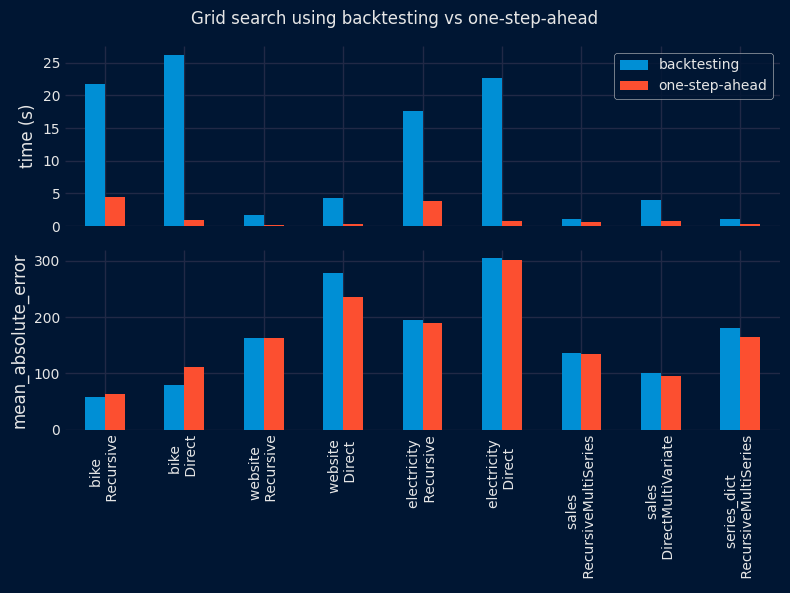
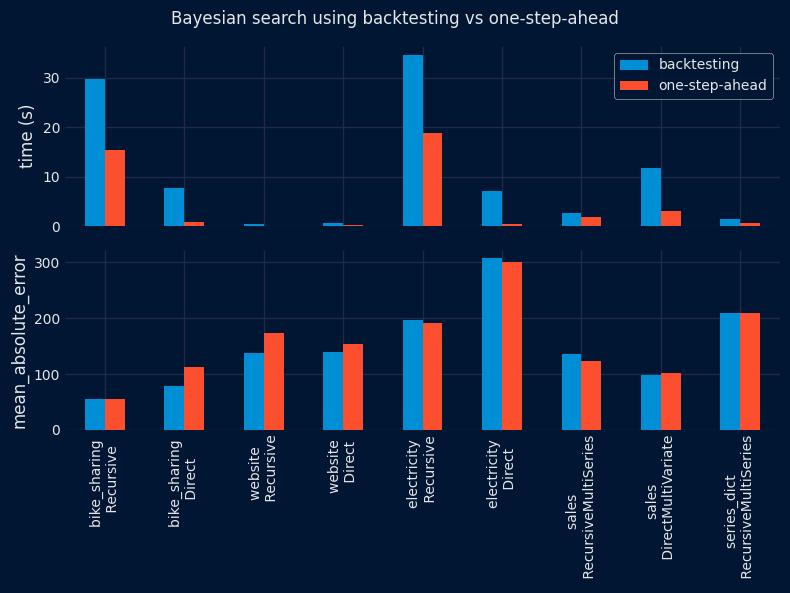
✎ Note
The purpose of this analysis is to compare the time and forecasting performance of the two available evaluation methods, not to compare different forecasters.
Libraries and data
# Libraries
# ==============================================================================
import platform
import psutil
import numpy as np
import pandas as pd
import matplotlib.pyplot as plt
from time import time
from copy import copy
import sklearn
import skforecast
import lightgbm
from lightgbm import LGBMRegressor
from sklearn.linear_model import Ridge
from sklearn.preprocessing import StandardScaler
from skforecast.datasets import fetch_dataset
from skforecast.plot import set_dark_theme
from skforecast.recursive import ForecasterRecursive
from skforecast.direct import ForecasterDirect
from skforecast.model_selection import TimeSeriesFold, OneStepAheadFold
from skforecast.model_selection import grid_search_forecaster
from skforecast.model_selection import bayesian_search_forecaster
from skforecast.model_selection import backtesting_forecaster
from skforecast.recursive import ForecasterRecursiveMultiSeries
from skforecast.direct import ForecasterDirectMultiVariate
from skforecast.model_selection import backtesting_forecaster_multiseries
from skforecast.model_selection import grid_search_forecaster_multiseries
from skforecast.model_selection import bayesian_search_forecaster_multiseries
from skforecast.preprocessing import reshape_series_long_to_dict
from skforecast.preprocessing import reshape_exog_long_to_dict

# Warnings
# ==============================================================================
import warnings
from skforecast.exceptions import IgnoredArgumentWarning
warnings.filterwarnings('ignore')
warnings.simplefilter('ignore', category=IgnoredArgumentWarning)
# Versions
# ==============================================================================
print(f"Python version      : {platform.python_version()}")
print(f"scikit-learn version: {sklearn.__version__}")
print(f"skforecast version  : {skforecast.__version__}")
print(f"lightgbm version    : {lightgbm.__version__}")
print(f"pandas version      : {pd.__version__}")
print(f"numpy version       : {np.__version__}")
print("")

# System information
# ==============================================================================
print(f"Machine type: {platform.machine()}")
print(f"Processor type: {platform.processor()}")
print(f"Platform type: {platform.platform()}")
print(f"Operating system: {platform.system()}")
print(f"Operating system release: {platform.release()}")
print(f"Operating system version: {platform.version()}")
print(f"Number of physical cores: {psutil.cpu_count(logical=False)}")
print(f"Number of logical cores: {psutil.cpu_count(logical=True)}")
Python version      : 3.13.11
scikit-learn version: 1.8.0
skforecast version  : 0.20.0
lightgbm version    : 4.6.0
pandas version      : 2.3.3
numpy version       : 2.3.5

Machine type: AMD64
Processor type: Intel64 Family 6 Model 141 Stepping 1, GenuineIntel
Platform type: Windows-11-10.0.26100-SP0
Operating system: Windows
Operating system release: 11
Operating system version: 10.0.26100
Number of physical cores: 8
Number of logical cores: 16
# Import data
# ==============================================================================
data_bike = fetch_dataset('bike_sharing_extended_features', verbose=False)

data_sales = fetch_dataset(name="items_sales", verbose=False)
data_sales = data_sales * 100
data_sales['day_of_week'] = data_sales.index.dayofweek

data_website = fetch_dataset(name="website_visits", raw=True, verbose=False)
data_website['date'] = pd.to_datetime(data_website['date'], format='%d/%m/%y')
data_website = data_website.set_index('date')
data_website = data_website.asfreq('1D')
data_website = data_website.sort_index()
data_website['month'] = data_website.index.month
data_website['month_day'] = data_website.index.day
data_website['week_day'] = data_website.index.day_of_week
data_website = pd.get_dummies(data_website, columns=['month', 'week_day', 'month_day'], dtype='int64')

data_electricity = fetch_dataset(name='vic_electricity', raw=False, verbose=False)
data_electricity = data_electricity.drop(columns="Date")
data_electricity = (
    data_electricity
    .resample(rule="h", closed="left", label="right")
    .agg({
        "Demand": "mean",
        "Temperature": "mean",
        "Holiday": "mean",
    })
)
data_electricity = data_electricity.loc['2012-01-01 00:00:00': '2013-12-30 23:00:00'].copy()

series_dict = pd.read_csv(
    'https://raw.githubusercontent.com/skforecast/skforecast-datasets/main/data/demo_multi_series.csv'
)
exog_dict = pd.read_csv(
    'https://raw.githubusercontent.com/skforecast/skforecast-datasets/main/data/demo_multi_series_exog.csv'
)
series_dict['timestamp'] = pd.to_datetime(series_dict['timestamp'])
exog_dict['timestamp'] = pd.to_datetime(exog_dict['timestamp'])

series_dict = reshape_series_long_to_dict(
    data      = series_dict,
    series_id = 'series_id',
    index     = 'timestamp',
    values    = 'value',
    freq      = 'D'
)
exog_dict = reshape_exog_long_to_dict(
    data      = exog_dict,
    series_id = 'series_id',
    index     = 'timestamp',
    freq      = 'D'
)
Benchmark
# Functions to compare results using backtesting and one step ahead
# ==============================================================================
def run_benchmark(
data,
forecaster_to_benchmark,
search_method = None,
lags_grid = None,
param_grid = None,
search_space = None,
end_train = None,
end_validation = None,
target = None,
exog_features = None,
steps = None,
metric = None
):
"""
Compare results of grid search and bayesian search using backtesting and one-step-ahead.
"""
# backtesting
forecaster = copy(forecaster_to_benchmark)
start = time()
cv = TimeSeriesFold(
initial_train_size = len(data.loc[:end_train]),
steps = steps,
refit = False,
)
if search_method == 'grid_search':
results_1 = grid_search_forecaster(
forecaster = forecaster,
y = data.loc[:end_validation, target],
exog = data.loc[:end_validation, exog_features] if exog_features else None,
cv = cv,
param_grid = param_grid,
lags_grid = lags_grid,
metric = metric,
return_best = False,
n_jobs = 'auto',
verbose = False,
show_progress = False
)
else:
results_1, _ = bayesian_search_forecaster(
forecaster = forecaster,
y = data.loc[:end_validation, target],
exog = data.loc[:end_validation, exog_features] if exog_features else None,
cv = cv,
search_space = search_space,
metric = metric,
n_trials = 15,
random_state = 123,
return_best = False,
n_jobs = 'auto',
verbose = False,
show_progress = False
)
end = time()
time_1 = end - start
best_params = results_1.loc[0, 'params']
best_lags = results_1.loc[0, 'lags']
forecaster.set_params(best_params)
forecaster.set_lags(lags=best_lags)
cv = TimeSeriesFold(
initial_train_size = len(data.loc[:end_validation]),
steps = steps,
refit = False,
)
metric_1, _ = backtesting_forecaster(
forecaster = forecaster,
y = data.loc[:, target],
exog = data.loc[:, exog_features] if exog_features else None,
cv = cv,
metric = metric,
verbose = False,
show_progress = False
)
# One step ahead
forecaster = copy(forecaster_to_benchmark)
start = time()
cv = OneStepAheadFold(initial_train_size = len(data.loc[:end_train]))
if search_method == 'grid_search':
results_2 = grid_search_forecaster(
forecaster = forecaster,
y = data.loc[:end_validation, target],
exog = data.loc[:end_validation, exog_features] if exog_features else None,
cv = cv,
param_grid = param_grid,
lags_grid = lags_grid,
metric = metric,
return_best = False,
verbose = False,
show_progress = False
)
else:
results_2, _ = bayesian_search_forecaster(
forecaster = forecaster,
y = data.loc[:end_validation, target],
exog = data.loc[:end_validation, exog_features] if exog_features else None,
cv = cv,
search_space = search_space,
metric = metric,
n_trials = 15,
random_state = 123,
return_best = False,
verbose = False,
show_progress = False
)
end = time()
time_2 = end - start
best_params = results_2.loc[0, 'params']
best_lags = results_2.loc[0, 'lags']
forecaster.set_params(best_params)
forecaster.set_lags(lags=best_lags)
cv = TimeSeriesFold(
initial_train_size = len(data.loc[:end_validation]),
steps = steps,
refit = False,
)
metric_2, _ = backtesting_forecaster(
forecaster = forecaster,
y = data.loc[:, target],
exog = data.loc[:, exog_features] if exog_features else None,
cv = cv,
metric = metric,
verbose = False,
show_progress = False
)
print("-----------------")
print("Benchmark results")
print("-----------------")
print('Execution time backtesting :', time_1)
print('Execution time one step ahead:', time_2)
print(f"Same lags : {np.array_equal(results_1.loc[0, 'lags'], results_2.loc[0, 'lags'])}")
print(f"Same params : {results_1.loc[0, 'params'] == results_2.loc[0, 'params']}")
print("")
print("Method: backtesting")
print(f" lags : {results_1.loc[0, 'lags']}")
print(f" params : {results_1.loc[0, 'params']}")
print(f" {metric}: {metric_1.loc[0, metric]}")
print("")
print("Method: one step ahead")
print(f" lags : {results_2.loc[0, 'lags']}")
print(f" params : {results_2.loc[0, 'params']}")
print(f" {metric}: {metric_2.loc[0, metric]}")
return time_1, time_2, metric_1.loc[0, metric], metric_2.loc[0, metric]
# Functions to compare results using backtesting and one step ahead
# ==============================================================================
def run_benchmark_multiseries(
data = None,
forecaster_to_benchmark = None,
search_method = None,
lags_grid = None,
param_grid = None,
search_space = None,
end_train = None,
end_validation = None,
levels = None,
exog_features = None,
steps = None,
metric = None
):
"""
Compare results of grid search using backtesting and one-step-ahead.
"""
# Backtesting
forecaster = copy(forecaster_to_benchmark)
start = time()
cv = TimeSeriesFold(
initial_train_size = len(data.loc[:end_train]),
steps = steps,
refit = False,
)
if search_method == 'grid_search':
results_1 = grid_search_forecaster_multiseries(
forecaster = forecaster,
series = data.loc[:end_validation, levels],
levels = levels,
exog = data.loc[:end_validation, exog_features] if exog_features else None,
cv = cv,
param_grid = param_grid,
lags_grid = lags_grid,
metric = metric,
return_best = False,
n_jobs = 'auto',
verbose = False,
show_progress = False
)
else:
results_1, _ = bayesian_search_forecaster_multiseries(
forecaster = forecaster,
series = data.loc[:end_validation, levels],
exog = data.loc[:end_validation, exog_features] if exog_features else None,
levels = levels,
search_space = search_space,
cv = cv,
metric = metric,
n_trials = 15,
random_state = 123,
return_best = False,
n_jobs = 'auto',
verbose = False,
show_progress = False
)
end = time()
time_1 = end - start
best_params = results_1.loc[0, 'params']
best_lags = results_1.loc[0, 'lags']
forecaster.set_params(best_params)
forecaster.set_lags(lags=best_lags)
cv = TimeSeriesFold(
initial_train_size = len(data.loc[:end_validation]),
steps = steps,
refit = False,
)
metric_1, _ = backtesting_forecaster_multiseries(
forecaster = forecaster,
series = data.loc[:, levels],
exog = data.loc[:, exog_features] if exog_features else None,
cv = cv,
levels = levels,
metric = metric,
verbose = False,
show_progress = False
)
# One step ahead
forecaster = copy(forecaster_to_benchmark)
start = time()
cv = OneStepAheadFold(initial_train_size = len(data.loc[:end_train]))
if search_method == 'grid_search':
results_2 = grid_search_forecaster_multiseries(
forecaster = forecaster,
series = data.loc[:end_validation, levels],
exog = data.loc[:end_validation, exog_features] if exog_features else None,
cv = cv,
levels = levels,
param_grid = param_grid,
lags_grid = lags_grid,
metric = metric,
return_best = False,
verbose = False,
show_progress = False
)
else:
results_2, _ = bayesian_search_forecaster_multiseries(
forecaster = forecaster,
series = data.loc[:end_validation, levels],
exog = data.loc[:end_validation, exog_features] if exog_features else None,
cv = cv,
levels = levels,
search_space = search_space,
metric = metric,
n_trials = 15,
random_state = 123,
return_best = False,
verbose = False,
show_progress = False
)
end = time()
time_2 = end - start
best_params = results_2.loc[0, 'params']
best_lags = results_2.loc[0, 'lags']
forecaster.set_params(best_params)
forecaster.set_lags(lags=best_lags)
cv = TimeSeriesFold(
initial_train_size = len(data.loc[:end_validation]),
steps = steps,
refit = False,
)
metric_2, _ = backtesting_forecaster_multiseries(
forecaster = forecaster,
series = data.loc[:, levels],
exog = data.loc[:, exog_features] if exog_features else None,
cv = cv,
levels = levels,
metric = metric,
verbose = False,
show_progress = False
)
print("Benchmark results")
print("-----------------")
print('Execution time backtesting :', time_1)
print('Execution time one step ahead:', time_2)
print(f"Same lags : {np.array_equal(results_1.loc[0, 'lags'], results_2.loc[0, 'lags'])}")
print(f"Same params : {results_1.loc[0, 'params'] == results_2.loc[0, 'params']}")
print("")
print("Method: backtesting")
print(f" lags : {results_1.loc[0, 'lags']}")
print(f" params : {results_1.loc[0, 'params']}")
print(f" {metric_1.loc[0, metric]}")
print("")
print("Method: one step ahead")
print(f" lags : {results_2.loc[0, 'lags']}")
print(f" params : {results_2.loc[0, 'params']}")
print(f" {metric_2.loc[0, metric]}")
return time_1, time_2, metric_1.loc[0, metric], metric_2.loc[0, metric]
def summarize_results(results, metric, title, plot=True, save_plot=None, fig_size=(8, 4)):
"""
Summarize results of benchmark.
"""
results = pd.DataFrame(
results,
columns=[
"dataset",
"forecaster",
"time_search_backtesting",
"time_search_one_step",
"metric_backtesting",
"metric_one_step",
]
)
results['ratio_speed'] = (
results['time_search_backtesting'] / results['time_search_one_step']
).round(2)
results['ratio_metric'] = (
results['metric_backtesting'] / results['metric_one_step']
).round(2)
results["dataset_forecaster"] = (
results["dataset"]
+ " \n "
+ results["forecaster"].str.replace("Forecaster", "")
)
display(results)
if plot:
set_dark_theme()
fig, axs = plt.subplots(2, 1, figsize=fig_size, sharex=True)
results.plot.bar(
x='dataset_forecaster',
y=['time_search_backtesting', 'time_search_one_step'],
ax=axs[0],
)
axs[0].set_ylabel('time (s)')
axs[0].legend(["backtesting", "one-step-ahead"])
results.plot.bar(
x='dataset_forecaster',
y=['metric_backtesting', 'metric_one_step'],
ax=axs[1],
legend=False
)
axs[1].set_ylabel(f'{metric}')
axs[1].set_xlabel('')
plt.xticks(rotation=90)
plt.suptitle(title)
plt.tight_layout()
if save_plot:
plt.savefig(save_plot, dpi=300, bbox_inches='tight')
Grid search
# Results
# ==============================================================================
results_grid_search = []
metric = 'mean_absolute_error'
# Dataset bike_sharing_extended_features - ForecasterRecursive
# ==============================================================================
end_train = '2012-03-31 23:59:00'
end_validation = '2012-08-31 23:59:00'
exog_features = [
    'month_sin', 'month_cos', 'week_of_year_sin', 'week_of_year_cos', 'week_day_sin',
    'week_day_cos', 'hour_day_sin', 'hour_day_cos', 'sunrise_hour_sin', 'sunrise_hour_cos',
    'sunset_hour_sin', 'sunset_hour_cos', 'holiday_previous_day', 'holiday_next_day',
    'temp_roll_mean_1_day', 'temp_roll_mean_7_day', 'temp_roll_max_1_day',
    'temp_roll_min_1_day', 'temp_roll_max_7_day', 'temp_roll_min_7_day',
    'temp', 'holiday'
]

forecaster = ForecasterRecursive(
                 estimator = LGBMRegressor(random_state=123, verbose=-1),
                 lags      = 10
             )
lags_grid = [48, 72, (1, 2, 3, 23, 24, 25, 167, 168, 169)]

param_grid = {
    'n_estimators': [100, 200],
    'max_depth': [3, 5],
    'learning_rate': [0.01, 0.1]
}

time_1, time_2, metric_1, metric_2 = run_benchmark(
    data                    = data_bike,
    forecaster_to_benchmark = forecaster,
    search_method           = 'grid_search',
    lags_grid               = lags_grid,
    param_grid              = param_grid,
    end_train               = end_train,
    end_validation          = end_validation,
    target                  = 'users',
    exog_features           = exog_features,
    steps                   = 24,
    metric                  = metric
)

results_grid_search.append([
    'bike',
    type(forecaster).__name__,
    time_1,
    time_2,
    metric_1,
    metric_2,
])
-----------------
Benchmark results
-----------------
Execution time backtesting   : 21.70058846473694
Execution time one step ahead: 4.505127668380737
Same lags   : False
Same params : True

Method: backtesting
    lags   : [  1   2   3  23  24  25 167 168 169]
    params : {'learning_rate': 0.1, 'max_depth': 3, 'n_estimators': 200}
    mean_absolute_error: 58.276762590192014

Method: one step ahead
    lags   : [ 1  2  3  4  5  6  7  8  9 10 11 12 13 14 15 16 17 18 19 20 21 22 23 24
 25 26 27 28 29 30 31 32 33 34 35 36 37 38 39 40 41 42 43 44 45 46 47 48
 49 50 51 52 53 54 55 56 57 58 59 60 61 62 63 64 65 66 67 68 69 70 71 72]
    params : {'learning_rate': 0.1, 'max_depth': 3, 'n_estimators': 200}
    mean_absolute_error: 64.04254202108999
# Dataset bike_sharing_extended_features - ForecasterDirect
# ==============================================================================
forecaster = ForecasterDirect(
                 estimator     = Ridge(random_state=123),
                 transformer_y = StandardScaler(),
                 steps         = 24,
                 lags          = 10
             )

lags_grid = [48, 72, (1, 2, 3, 23, 24, 25, 167, 168, 169)]

param_grid = {'alpha': np.logspace(-3, 3, 20)}

time_1, time_2, metric_1, metric_2 = run_benchmark(
    data                    = data_bike,
    forecaster_to_benchmark = forecaster,
    search_method           = 'grid_search',
    lags_grid               = lags_grid,
    param_grid              = param_grid,
    end_train               = end_train,
    end_validation          = end_validation,
    target                  = 'users',
    exog_features           = exog_features,
    steps                   = 24,
    metric                  = metric
)
results_grid_search.append([
    'bike',
    type(forecaster).__name__,
    time_1,
    time_2,
    metric_1,
    metric_2,
])
-----------------
Benchmark results
-----------------
Execution time backtesting   : 26.229192972183228
Execution time one step ahead: 0.9595901966094971
Same lags   : False
Same params : False

Method: backtesting
    lags   : [ 1  2  3  4  5  6  7  8  9 10 11 12 13 14 15 16 17 18 19 20 21 22 23 24
 25 26 27 28 29 30 31 32 33 34 35 36 37 38 39 40 41 42 43 44 45 46 47 48
 49 50 51 52 53 54 55 56 57 58 59 60 61 62 63 64 65 66 67 68 69 70 71 72]
    params : {'alpha': np.float64(112.88378916846884)}
    mean_absolute_error: 79.14111581771633

Method: one step ahead
    lags   : [  1   2   3  23  24  25 167 168 169]
    params : {'alpha': np.float64(12.742749857031322)}
    mean_absolute_error: 111.95615163625295
# Dataset website_visits - ForecasterRecursive
# ==============================================================================
end_train = '2021-03-30 23:59:00'
end_validation = '2021-06-30 23:59:00'
exog_features = [col for col in data_website.columns if col.startswith(('month_', 'week_day_', 'month_day_'))]

forecaster = ForecasterRecursive(
                 estimator     = Ridge(random_state=123),
                 transformer_y = StandardScaler(),
                 lags          = 10
             )

lags_grid = [7, 14, 21, [7, 14, 21]]

param_grid = {'alpha': np.logspace(-3, 3, 20)}

time_1, time_2, metric_1, metric_2 = run_benchmark(
    data                    = data_website,
    forecaster_to_benchmark = forecaster,
    search_method           = 'grid_search',
    lags_grid               = lags_grid,
    param_grid              = param_grid,
    end_train               = end_train,
    end_validation          = end_validation,
    target                  = 'users',
    exog_features           = exog_features,
    steps                   = 7,
    metric                  = metric
)
results_grid_search.append([
    'website',
    type(forecaster).__name__,
    time_1,
    time_2,
    metric_1,
    metric_2,
])
-----------------
Benchmark results
-----------------
Execution time backtesting   : 1.6604857444763184
Execution time one step ahead: 0.25258755683898926
Same lags   : True
Same params : False

Method: backtesting
    lags   : [ 1  2  3  4  5  6  7  8  9 10 11 12 13 14]
    params : {'alpha': np.float64(6.158482110660261)}
    mean_absolute_error: 162.11396980738846

Method: one step ahead
    lags   : [ 1  2  3  4  5  6  7  8  9 10 11 12 13 14]
    params : {'alpha': np.float64(2.976351441631316)}
    mean_absolute_error: 162.35163466017403
# Dataset website_visits - ForecasterDirect
# ==============================================================================
forecaster = ForecasterDirect(
                 estimator = Ridge(random_state=123),
                 steps     = 24,
                 lags      = 10
             )

lags_grid = [7, 14, 21, [7, 14, 21]]

param_grid = {'alpha': np.logspace(-3, 3, 20)}

time_1, time_2, metric_1, metric_2 = run_benchmark(
    data                    = data_website,
    forecaster_to_benchmark = forecaster,
    search_method           = 'grid_search',
    lags_grid               = lags_grid,
    param_grid              = param_grid,
    end_train               = end_train,
    end_validation          = end_validation,
    target                  = 'users',
    exog_features           = exog_features,
    steps                   = 24,
    metric                  = metric
)
results_grid_search.append([
    'website',
    type(forecaster).__name__,
    time_1,
    time_2,
    metric_1,
    metric_2,
])
-----------------
Benchmark results
-----------------
Execution time backtesting   : 4.337159156799316
Execution time one step ahead: 0.39861249923706055
Same lags   : True
Same params : False

Method: backtesting
    lags   : [ 1  2  3  4  5  6  7  8  9 10 11 12 13 14]
    params : {'alpha': np.float64(6.158482110660261)}
    mean_absolute_error: 277.8362513175126

Method: one step ahead
    lags   : [ 1  2  3  4  5  6  7  8  9 10 11 12 13 14]
    params : {'alpha': np.float64(1.438449888287663)}
    mean_absolute_error: 236.28560218972453
# Dataset vic_electricity - ForecasterRecursive
# ==============================================================================
end_train = '2013-06-30 23:59:00'
end_validation = '2013-11-30 23:59:00'
exog_features = ['Temperature', 'Holiday']

forecaster = ForecasterRecursive(
                 estimator = LGBMRegressor(random_state=123, verbose=-1),
                 lags      = 10
             )

lags_grid = [48, 72, (1, 2, 3, 23, 24, 25, 167, 168, 169)]

param_grid = {
    'n_estimators': [100, 200],
    'max_depth': [3, 5],
    'learning_rate': [0.01, 0.1]
}

time_1, time_2, metric_1, metric_2 = run_benchmark(
    data                    = data_electricity,
    forecaster_to_benchmark = forecaster,
    search_method           = 'grid_search',
    lags_grid               = lags_grid,
    param_grid              = param_grid,
    end_train               = end_train,
    end_validation          = end_validation,
    target                  = 'Demand',
    exog_features           = exog_features,
    steps                   = 24,
    metric                  = metric
)
results_grid_search.append([
    'electricity',
    type(forecaster).__name__,
    time_1,
    time_2,
    metric_1,
    metric_2,
])
-----------------
Benchmark results
-----------------
Execution time backtesting   : 17.651525259017944
Execution time one step ahead: 3.8753225803375244
Same lags   : False
Same params : True

Method: backtesting
    lags   : [  1   2   3  23  24  25 167 168 169]
    params : {'learning_rate': 0.1, 'max_depth': 5, 'n_estimators': 200}
    mean_absolute_error: 194.83553235066182

Method: one step ahead
    lags   : [ 1  2  3  4  5  6  7  8  9 10 11 12 13 14 15 16 17 18 19 20 21 22 23 24
 25 26 27 28 29 30 31 32 33 34 35 36 37 38 39 40 41 42 43 44 45 46 47 48
 49 50 51 52 53 54 55 56 57 58 59 60 61 62 63 64 65 66 67 68 69 70 71 72]
    params : {'learning_rate': 0.1, 'max_depth': 5, 'n_estimators': 200}
    mean_absolute_error: 188.8782299908785
# Dataset vic_electricity - ForecasterDirect
# ==============================================================================
forecaster = ForecasterDirect(
                 estimator     = Ridge(random_state=123),
                 transformer_y = StandardScaler(),
                 steps         = 24,
                 lags          = 10
             )

lags_grid = [48, 72, (1, 2, 3, 23, 24, 25, 167, 168, 169)]

param_grid = {'alpha': np.logspace(-3, 3, 20)}

time_1, time_2, metric_1, metric_2 = run_benchmark(
    data                    = data_electricity,
    forecaster_to_benchmark = forecaster,
    search_method           = 'grid_search',
    lags_grid               = lags_grid,
    param_grid              = param_grid,
    end_train               = end_train,
    end_validation          = end_validation,
    target                  = 'Demand',
    exog_features           = exog_features,
    steps                   = 24,
    metric                  = metric
)
results_grid_search.append([
    'electricity',
    type(forecaster).__name__,
    time_1,
    time_2,
    metric_1,
    metric_2,
])
-----------------
Benchmark results
-----------------
Execution time backtesting   : 22.634162425994873
Execution time one step ahead: 0.7843093872070312
Same lags   : True
Same params : False

Method: backtesting
    lags   : [ 1  2  3  4  5  6  7  8  9 10 11 12 13 14 15 16 17 18 19 20 21 22 23 24
 25 26 27 28 29 30 31 32 33 34 35 36 37 38 39 40 41 42 43 44 45 46 47 48
 49 50 51 52 53 54 55 56 57 58 59 60 61 62 63 64 65 66 67 68 69 70 71 72]
    params : {'alpha': np.float64(6.158482110660261)}
    mean_absolute_error: 304.22332781257774

Method: one step ahead
    lags   : [ 1  2  3  4  5  6  7  8  9 10 11 12 13 14 15 16 17 18 19 20 21 22 23 24
 25 26 27 28 29 30 31 32 33 34 35 36 37 38 39 40 41 42 43 44 45 46 47 48
 49 50 51 52 53 54 55 56 57 58 59 60 61 62 63 64 65 66 67 68 69 70 71 72]
    params : {'alpha': np.float64(1.438449888287663)}
    mean_absolute_error: 301.70709717630535
# Dataset sales - ForecasterRecursiveMultiSeries
# ==============================================================================
end_train = '2014-05-15 23:59:00'
end_validation = '2014-07-15 23:59:00'
levels = ['item_1', 'item_2', 'item_3']
exog_features = ['day_of_week']

forecaster = ForecasterRecursiveMultiSeries(
                 estimator          = LGBMRegressor(random_state=123, verbose=-1),
                 lags               = 24,
                 encoding           = "ordinal",
                 transformer_series = None,
                 transformer_exog   = None,
                 weight_func        = None,
                 series_weights     = None,
                 differentiation    = None,
                 dropna_from_series = False,
                 fit_kwargs         = None,
                 forecaster_id      = None
             )

lags_grid = {
    '24 lags': 24,
    '48 lags': 48
}

param_grid = {
    'n_estimators': [50, 200],
    'max_depth': [3, 7]
}

time_1, time_2, metric_1, metric_2 = run_benchmark_multiseries(
    data                    = data_sales,
    forecaster_to_benchmark = forecaster,
    search_method           = 'grid_search',
    lags_grid               = lags_grid,
    param_grid              = param_grid,
    end_train               = end_train,
    end_validation          = end_validation,
    levels                  = levels,
    exog_features           = exog_features,
    steps                   = 36,
    metric                  = metric
)
results_grid_search.append([
    'sales',
    type(forecaster).__name__,
    time_1,
    time_2,
    metric_1,
    metric_2,
])
Benchmark results
-----------------
Execution time backtesting   : 1.0920603275299072
Execution time one step ahead: 0.6482408046722412
Same lags   : False
Same params : False

Method: backtesting
    lags   : [ 1  2  3  4  5  6  7  8  9 10 11 12 13 14 15 16 17 18 19 20 21 22 23 24]
    params : {'max_depth': 7, 'n_estimators': 200}
    137.16940500432474

Method: one step ahead
    lags   : [ 1  2  3  4  5  6  7  8  9 10 11 12 13 14 15 16 17 18 19 20 21 22 23 24
 25 26 27 28 29 30 31 32 33 34 35 36 37 38 39 40 41 42 43 44 45 46 47 48]
    params : {'max_depth': 3, 'n_estimators': 50}
    134.76669158338447
# Dataset sales - ForecasterDirectMultiVariate
# ==============================================================================
forecaster = ForecasterDirectMultiVariate(
                 estimator          = LGBMRegressor(random_state=123, verbose=-1),
                 lags               = 24,
                 steps              = 5,
                 level              = 'item_1',
                 transformer_series = None,
                 transformer_exog   = None,
                 weight_func        = None,
                 fit_kwargs         = None,
                 forecaster_id      = None
             )

lags_grid = {
    '24 lags': 24,
    '48 lags': 48
}

param_grid = {
    'n_estimators': [50, 200],
    'max_depth': [3, 7]
}

time_1, time_2, metric_1, metric_2 = run_benchmark_multiseries(
    data                    = data_sales,
    forecaster_to_benchmark = forecaster,
    search_method           = 'grid_search',
    lags_grid               = lags_grid,
    param_grid              = param_grid,
    end_train               = end_train,
    end_validation          = end_validation,
    levels                  = levels,
    exog_features           = exog_features,
    steps                   = 5,
    metric                  = metric
)

results_grid_search.append([
    'sales',
    type(forecaster).__name__,
    time_1,
    time_2,
    metric_1,
    metric_2,
])
Benchmark results
-----------------
Execution time backtesting   : 4.021717071533203
Execution time one step ahead: 0.7637064456939697
Same lags   : False
Same params : True

Method: backtesting
    lags   : [ 1  2  3  4  5  6  7  8  9 10 11 12 13 14 15 16 17 18 19 20 21 22 23 24]
    params : {'max_depth': 7, 'n_estimators': 50}
    100.16441146410313

Method: one step ahead
    lags   : [ 1  2  3  4  5  6  7  8  9 10 11 12 13 14 15 16 17 18 19 20 21 22 23 24
 25 26 27 28 29 30 31 32 33 34 35 36 37 38 39 40 41 42 43 44 45 46 47 48]
    params : {'max_depth': 7, 'n_estimators': 50}
    95.20010578089475
# Dataset series_dict - ForecasterRecursiveMultiSeries
# ==============================================================================
end_train = '2016-05-31 23:59:00'
end_validation = '2016-07-31 23:59:00'
levels = ['id_1000', 'id_1001', 'id_1002', 'id_1003', 'id_1004']
series_dict_train = {k: v.loc[: end_train,] for k, v in series_dict.items()}
exog_dict_train   = {k: v.loc[: end_train,] for k, v in exog_dict.items()}
series_dict_test  = {k: v.loc[end_train:,] for k, v in series_dict.items()}
exog_dict_test    = {k: v.loc[end_train:,] for k, v in exog_dict.items()}

forecaster_to_benchmark = ForecasterRecursiveMultiSeries(
                              estimator          = LGBMRegressor(random_state=123, verbose=-1),
                              lags               = 24,
                              encoding           = "ordinal",
                              transformer_series = None,
                              transformer_exog   = None,
                              weight_func        = None,
                              series_weights     = None,
                              differentiation    = None,
                              dropna_from_series = False,
                              fit_kwargs         = None,
                              forecaster_id      = None
                          )
lags_grid = [7, 14]
param_grid = {
    'n_estimators': [50, 200],
    'max_depth': [3, 7]
}

# Backtesting
forecaster = copy(forecaster_to_benchmark)
start  = time()
cv = TimeSeriesFold(
        initial_train_size = 100,
        steps              = 24,
        refit              = False
     )
results_1 = grid_search_forecaster_multiseries(
                forecaster        = forecaster,
                series            = {k: v.loc[: end_validation,] for k, v in series_dict.items()},
                exog              = {k: v.loc[: end_validation,] for k, v in exog_dict.items()},
                cv                = cv,
                param_grid        = param_grid,
                lags_grid         = lags_grid,
                metric            = metric,
                return_best       = False,
                n_jobs            = 'auto',
                verbose           = False,
                show_progress     = False,
                suppress_warnings = True
            )
end = time()
time_1 = end - start
best_params = results_1.loc[0, 'params']
best_lags = results_1.loc[0, 'lags']
forecaster.set_params(best_params)
forecaster.set_lags(lags=best_lags)
cv = TimeSeriesFold(
        initial_train_size = 213,
        steps              = 24,
        refit              = False
     )
metric_1, pred_1 = backtesting_forecaster_multiseries(
                       forecaster        = forecaster,
                       series            = series_dict,
                       exog              = exog_dict,
                       cv                = cv,
                       levels            = levels,
                       metric            = metric,
                       verbose           = False,
                       show_progress     = False,
                       suppress_warnings = True
                   )

# One step ahead
forecaster = copy(forecaster_to_benchmark)
start  = time()
cv = OneStepAheadFold(initial_train_size = 100)
results_2 = grid_search_forecaster_multiseries(
                forecaster        = forecaster,
                series            = {k: v.loc[: end_validation,] for k, v in series_dict.items()},
                exog              = {k: v.loc[: end_validation,] for k, v in exog_dict.items()},
                cv                = cv,
                levels            = levels,
                param_grid        = param_grid,
                lags_grid         = lags_grid,
                metric            = metric,
                return_best       = False,
                verbose           = False,
                show_progress     = False,
                suppress_warnings = True
            )
end = time()
time_2 = end - start
best_params = results_2.loc[0, 'params']
best_lags = results_2.loc[0, 'lags']
forecaster.set_params(best_params)
forecaster.set_lags(lags=best_lags)
cv = TimeSeriesFold(
        initial_train_size = 213,
        steps              = 24,
        refit              = False
     )
metric_2, pred_2 = backtesting_forecaster_multiseries(
                       forecaster        = forecaster,
                       series            = series_dict,
                       exog              = exog_dict,
                       cv                = cv,
                       levels            = levels,
                       metric            = metric,
                       verbose           = False,
                       show_progress     = False,
                       suppress_warnings = True
                   )

print("Benchmark results")
print("-----------------")
print('Execution time backtesting   :', time_1)
print('Execution time one step ahead:', time_2)
print(f"Same lags   : {np.array_equal(results_1.loc[0, 'lags'], results_2.loc[0, 'lags'])}")
print(f"Same params : {results_1.loc[0, 'params'] == results_2.loc[0, 'params']}")
print("")
print("Method: backtesting")
print(f"    lags   : {results_1.loc[0, 'lags']}")
print(f"    params : {results_1.loc[0, 'params']}")
print(f"    {metric_1.loc[0, metric]}")
print("")
print("Method: one step ahead")
print(f"    lags   : {results_2.loc[0, 'lags']}")
print(f"    params : {results_2.loc[0, 'params']}")
print(f"    {metric_2.loc[0, metric]}")

results_grid_search.append([
    'series_dict',
    type(forecaster).__name__,
    time_1,
    time_2,
    metric_1.loc[0, metric],
    metric_2.loc[0, metric],
])
Benchmark results
-----------------
Execution time backtesting   : 1.0911922454833984
Execution time one step ahead: 0.334500789642334
Same lags   : False
Same params : False

Method: backtesting
    lags   : [1 2 3 4 5 6 7]
    params : {'max_depth': 3, 'n_estimators': 50}
    180.46141171905165

Method: one step ahead
    lags   : [ 1  2  3  4  5  6  7  8  9 10 11 12 13 14]
    params : {'max_depth': 7, 'n_estimators': 50}
    164.23659500870002
# Results
# ==============================================================================
summarize_results(
    results   = results_grid_search,
    metric    = metric,
    plot      = True,
    fig_size  = (8, 6),
    title     = 'Grid search using backtesting vs one-step-ahead',
    save_plot = "../img/grid_search_benchmark.png"
)
| dataset | forecaster | time_search_backtesting | time_search_one_step | metric_backtesting | metric_one_step | ratio_speed | ratio_metric | dataset_forecaster | |
|---|---|---|---|---|---|---|---|---|---|
| 0 | bike | ForecasterRecursive | 21.700588 | 4.505128 | 58.276763 | 64.042542 | 4.82 | 0.91 | bike \n Recursive |
| 1 | bike | ForecasterDirect | 26.229193 | 0.959590 | 79.141116 | 111.956152 | 27.33 | 0.71 | bike \n Direct |
| 2 | website | ForecasterRecursive | 1.660486 | 0.252588 | 162.113970 | 162.351635 | 6.57 | 1.00 | website \n Recursive |
| 3 | website | ForecasterDirect | 4.337159 | 0.398612 | 277.836251 | 236.285602 | 10.88 | 1.18 | website \n Direct |
| 4 | electricity | ForecasterRecursive | 17.651525 | 3.875323 | 194.835532 | 188.878230 | 4.55 | 1.03 | electricity \n Recursive |
| 5 | electricity | ForecasterDirect | 22.634162 | 0.784309 | 304.223328 | 301.707097 | 28.86 | 1.01 | electricity \n Direct |
| 6 | sales | ForecasterRecursiveMultiSeries | 1.092060 | 0.648241 | 137.169405 | 134.766692 | 1.68 | 1.02 | sales \n RecursiveMultiSeries |
| 7 | sales | ForecasterDirectMultiVariate | 4.021717 | 0.763706 | 100.164411 | 95.200106 | 5.27 | 1.05 | sales \n DirectMultiVariate |
| 8 | series_dict | ForecasterRecursiveMultiSeries | 1.091192 | 0.334501 | 180.461412 | 164.236595 | 3.26 | 1.10 | series_dict \n RecursiveMultiSeries |

Bayesian search
# Table to store results
# ==============================================================================
results_bayesian_search = []
metric = 'mean_absolute_error'
# Dataset bike_sharing_extended_features - ForecasterRecursive
# ==============================================================================
end_train = '2012-03-31 23:59:00'
end_validation = '2012-08-31 23:59:00'
exog_features = [
    'month_sin', 'month_cos', 'week_of_year_sin', 'week_of_year_cos', 'week_day_sin',
    'week_day_cos', 'hour_day_sin', 'hour_day_cos', 'sunrise_hour_sin', 'sunrise_hour_cos',
    'sunset_hour_sin', 'sunset_hour_cos', 'holiday_previous_day', 'holiday_next_day',
    'temp_roll_mean_1_day', 'temp_roll_mean_7_day', 'temp_roll_max_1_day',
    'temp_roll_min_1_day', 'temp_roll_max_7_day', 'temp_roll_min_7_day',
    'temp', 'holiday'
]

forecaster = ForecasterRecursive(
                 estimator = LGBMRegressor(random_state=123, verbose=-1),
                 lags      = 10
             )

lags_grid = [48, 72, (1, 2, 3, 23, 24, 25, 167, 168, 169)]


def search_space(trial):
    search_space  = {
        'n_estimators' : trial.suggest_int('n_estimators', 400, 1200, step=100),
        'max_depth'    : trial.suggest_int('max_depth', 3, 10, step=1),
        'learning_rate': trial.suggest_float('learning_rate', 0.01, 1),
        'gamma'        : trial.suggest_float('gamma', 0, 1),
        'reg_alpha'    : trial.suggest_float('reg_alpha', 0, 1),
        'reg_lambda'   : trial.suggest_float('reg_lambda', 0, 1),
        'lags'         : trial.suggest_categorical('lags', lags_grid)
    }

    return search_space


time_1, time_2, metric_1, metric_2 = run_benchmark(
    data                    = data_bike,
    forecaster_to_benchmark = forecaster,
    search_method           = 'bayesian_search',
    search_space            = search_space,
    end_train               = end_train,
    end_validation          = end_validation,
    target                  = 'users',
    exog_features           = exog_features,
    steps                   = 24,
    metric                  = metric
)

results_bayesian_search.append([
    'bike_sharing',
    type(forecaster).__name__,
    time_1,
    time_2,
    metric_1,
    metric_2,
])
╭─────────────────────────── OneStepAheadValidationWarning ────────────────────────────╮
│ One-step-ahead predictions are used for faster model comparison, but they may not    │
│ fully represent multi-step prediction performance. It is recommended to backtest the │
│ final model for a more accurate multi-step performance estimate.                     │
│                                                                                      │
│ Category : skforecast.exceptions.OneStepAheadValidationWarning                       │
│ Location :                                                                           │
│ c:\Users\jaesc2\Miniconda3\envs\skforecast_py13\Lib\site-packages\skforecast\model_s │
│ election\_utils.py:616                                                               │
│ Suppress : warnings.simplefilter('ignore', category=OneStepAheadValidationWarning)   │
╰──────────────────────────────────────────────────────────────────────────────────────╯
-----------------
Benchmark results
-----------------
Execution time backtesting   : 29.762901306152344
Execution time one step ahead: 15.314664840698242
Same lags   : True
Same params : True

Method: backtesting
    lags   : [  1   2   3  23  24  25 167 168 169]
    params : {'n_estimators': 1200, 'max_depth': 10, 'learning_rate': 0.017833474222028745, 'gamma': 0.2285821738161964, 'reg_alpha': 0.23797728006705568, 'reg_lambda': 0.9887301767538854}
    mean_absolute_error: 55.80577702511614

Method: one step ahead
    lags   : [  1   2   3  23  24  25 167 168 169]
    params : {'n_estimators': 1200, 'max_depth': 10, 'learning_rate': 0.017833474222028745, 'gamma': 0.2285821738161964, 'reg_alpha': 0.23797728006705568, 'reg_lambda': 0.9887301767538854}
    mean_absolute_error: 55.80577702511614
# Dataset bike_sharing_extended_features - ForecasterDirect
# ==============================================================================
forecaster = ForecasterDirect(
                 estimator     = Ridge(random_state=123),
                 transformer_y = StandardScaler(),
                 steps         = 24,
                 lags          = 10
             )

lags_grid = [48, 72, (1, 2, 3, 23, 24, 25, 167, 168, 169)]


def search_space(trial):
    search_space  = {
        'alpha': trial.suggest_float('alpha', 0.001, 1000, log=True),
        'lags' : trial.suggest_categorical('lags', lags_grid)
    }

    return search_space


time_1, time_2, metric_1, metric_2 = run_benchmark(
    data                    = data_bike,
    forecaster_to_benchmark = forecaster,
    search_method           = 'bayesian_search',
    search_space            = search_space,
    end_train               = end_train,
    end_validation          = end_validation,
    target                  = 'users',
    exog_features           = exog_features,
    steps                   = 24,
    metric                  = metric
)

results_bayesian_search.append([
    'bike_sharing',
    type(forecaster).__name__,
    time_1,
    time_2,
    metric_1,
    metric_2,
])
╭─────────────────────────── OneStepAheadValidationWarning ────────────────────────────╮
│ One-step-ahead predictions are used for faster model comparison, but they may not    │
│ fully represent multi-step prediction performance. It is recommended to backtest the │
│ final model for a more accurate multi-step performance estimate.                     │
│                                                                                      │
│ Category : skforecast.exceptions.OneStepAheadValidationWarning                       │
│ Location :                                                                           │
│ c:\Users\jaesc2\Miniconda3\envs\skforecast_py13\Lib\site-packages\skforecast\model_s │
│ election\_utils.py:616                                                               │
│ Suppress : warnings.simplefilter('ignore', category=OneStepAheadValidationWarning)   │
╰──────────────────────────────────────────────────────────────────────────────────────╯
-----------------
Benchmark results
-----------------
Execution time backtesting   : 7.641877174377441
Execution time one step ahead: 0.7768850326538086
Same lags   : False
Same params : False

Method: backtesting
    lags   : [ 1  2  3  4  5  6  7  8  9 10 11 12 13 14 15 16 17 18 19 20 21 22 23 24
 25 26 27 28 29 30 31 32 33 34 35 36 37 38 39 40 41 42 43 44 45 46 47 48
 49 50 51 52 53 54 55 56 57 58 59 60 61 62 63 64 65 66 67 68 69 70 71 72]
    params : {'alpha': 121.0898788312409}
    mean_absolute_error: 79.14983372140252

Method: one step ahead
    lags   : [  1   2   3  23  24  25 167 168 169]
    params : {'alpha': 15.094374246471325}
    mean_absolute_error: 111.9620873402686
# Dataset website_visits - ForecasterRecursive
# ==============================================================================
end_train = '2021-03-30 23:59:00'
end_validation = '2021-06-30 23:59:00'
exog_features = [col for col in data_website.columns if col.startswith(('month_', 'week_day_', 'month_day_'))]

forecaster = ForecasterRecursive(
                 estimator     = Ridge(random_state=123),
                 transformer_y = StandardScaler(),
                 lags          = 10
             )

lags_grid = [7, 14, 21, [7, 14, 21]]


def search_space(trial):
    search_space  = {
        'alpha': trial.suggest_float('alpha', 0.001, 1000, log=True),
        'lags' : trial.suggest_categorical('lags', lags_grid)
    }

    return search_space


time_1, time_2, metric_1, metric_2 = run_benchmark(
    data                    = data_website,
    forecaster_to_benchmark = forecaster,
    search_method           = 'bayesian_search',
    search_space            = search_space,
    end_train               = end_train,
    end_validation          = end_validation,
    target                  = 'users',
    exog_features           = exog_features,
    steps                   = 7,
    metric                  = metric
)

results_bayesian_search.append([
    'website',
    type(forecaster).__name__,
    time_1,
    time_2,
    metric_1,
    metric_2,
])
╭─────────────────────────── OneStepAheadValidationWarning ────────────────────────────╮
│ One-step-ahead predictions are used for faster model comparison, but they may not    │
│ fully represent multi-step prediction performance. It is recommended to backtest the │
│ final model for a more accurate multi-step performance estimate.                     │
│                                                                                      │
│ Category : skforecast.exceptions.OneStepAheadValidationWarning                       │
│ Location :                                                                           │
│ c:\Users\jaesc2\Miniconda3\envs\skforecast_py13\Lib\site-packages\skforecast\model_s │
│ election\_utils.py:616                                                               │
│ Suppress : warnings.simplefilter('ignore', category=OneStepAheadValidationWarning)   │
╰──────────────────────────────────────────────────────────────────────────────────────╯
-----------------
Benchmark results
-----------------
Execution time backtesting   : 0.3589046001434326
Execution time one step ahead: 0.12133193016052246
Same lags   : False
Same params : False

Method: backtesting
    lags   : [ 1  2  3  4  5  6  7  8  9 10 11 12 13 14 15 16 17 18 19 20 21]
    params : {'alpha': 0.07474245141964296}
    mean_absolute_error: 136.76802274106473

Method: one step ahead
    lags   : [ 1  2  3  4  5  6  7  8  9 10 11 12 13 14]
    params : {'alpha': 0.03182234592129467}
    mean_absolute_error: 173.52829988091955
# Dataset website_visits - ForecasterDirect
# ==============================================================================
forecaster = ForecasterDirect(
                 estimator     = Ridge(random_state=123),
                 transformer_y = StandardScaler(),
                 lags          = 10,
                 steps         = 7
             )

lags_grid = [7, 14, 21, [7, 14, 21]]


def search_space(trial):
    search_space  = {
        'alpha': trial.suggest_float('alpha', 0.001, 1000, log=True),
        'lags' : trial.suggest_categorical('lags', lags_grid)
    }

    return search_space


time_1, time_2, metric_1, metric_2 = run_benchmark(
    data                    = data_website,
    forecaster_to_benchmark = forecaster,
    search_method           = 'bayesian_search',
    search_space            = search_space,
    end_train               = end_train,
    end_validation          = end_validation,
    target                  = 'users',
    exog_features           = exog_features,
    steps                   = 7,
    metric                  = metric
)

results_bayesian_search.append([
    'website',
    type(forecaster).__name__,
    time_1,
    time_2,
    metric_1,
    metric_2,
])
╭─────────────────────────── OneStepAheadValidationWarning ────────────────────────────╮
│ One-step-ahead predictions are used for faster model comparison, but they may not    │
│ fully represent multi-step prediction performance. It is recommended to backtest the │
│ final model for a more accurate multi-step performance estimate.                     │
│                                                                                      │
│ Category : skforecast.exceptions.OneStepAheadValidationWarning                       │
│ Location :                                                                           │
│ c:\Users\jaesc2\Miniconda3\envs\skforecast_py13\Lib\site-packages\skforecast\model_s │
│ election\_utils.py:616                                                               │
│ Suppress : warnings.simplefilter('ignore', category=OneStepAheadValidationWarning)   │
╰──────────────────────────────────────────────────────────────────────────────────────╯
-----------------
Benchmark results
-----------------
Execution time backtesting   : 0.6247999668121338
Execution time one step ahead: 0.15517139434814453
Same lags   : False
Same params : False

Method: backtesting
    lags   : [ 1  2  3  4  5  6  7  8  9 10 11 12 13 14 15 16 17 18 19 20 21]
    params : {'alpha': 0.07474245141964296}
    mean_absolute_error: 139.40123604697365

Method: one step ahead
    lags   : [ 1  2  3  4  5  6  7  8  9 10 11 12 13 14]
    params : {'alpha': 0.03182234592129467}
    mean_absolute_error: 153.6723680506675
# Dataset vic_electricity - ForecasterRecursive
# ==============================================================================
end_train = '2013-06-30 23:59:00'
end_validation = '2013-11-30 23:59:00'
exog_features = ['Temperature', 'Holiday']

forecaster = ForecasterRecursive(
                 estimator = LGBMRegressor(random_state=123, verbose=-1),
                 lags      = 10
             )

lags_grid = [48, 72, (1, 2, 3, 23, 24, 25, 167, 168, 169)]


def search_space(trial):
    search_space  = {
        'n_estimators' : trial.suggest_int('n_estimators', 400, 1200, step=100),
        'max_depth'    : trial.suggest_int('max_depth', 3, 10, step=1),
        'learning_rate': trial.suggest_float('learning_rate', 0.01, 1),
        'gamma'        : trial.suggest_float('gamma', 0, 1),
        'reg_alpha'    : trial.suggest_float('reg_alpha', 0, 1),
        'reg_lambda'   : trial.suggest_float('reg_lambda', 0, 1),
        'lags'         : trial.suggest_categorical('lags', lags_grid)
    }
    return search_space


time_1, time_2, metric_1, metric_2 = run_benchmark(
    data                    = data_electricity,
    forecaster_to_benchmark = forecaster,
    search_method           = 'bayesian_search',
    search_space            = search_space,
    end_train               = end_train,
    end_validation          = end_validation,
    target                  = 'Demand',
    exog_features           = exog_features,
    steps                   = 24,
    metric                  = metric
)

results_bayesian_search.append([
    'electricity',
    type(forecaster).__name__,
    time_1,
    time_2,
    metric_1,
    metric_2,
])
╭─────────────────────────── OneStepAheadValidationWarning ────────────────────────────╮
│ One-step-ahead predictions are used for faster model comparison, but they may not    │
│ fully represent multi-step prediction performance. It is recommended to backtest the │
│ final model for a more accurate multi-step performance estimate.                     │
│                                                                                      │
│ Category : skforecast.exceptions.OneStepAheadValidationWarning                       │
│ Location :                                                                           │
│ c:\Users\jaesc2\Miniconda3\envs\skforecast_py13\Lib\site-packages\skforecast\model_s │
│ election\_utils.py:616                                                               │
│ Suppress : warnings.simplefilter('ignore', category=OneStepAheadValidationWarning)   │
╰──────────────────────────────────────────────────────────────────────────────────────╯
-----------------
Benchmark results
-----------------
Execution time backtesting   : 34.64627146720886
Execution time one step ahead: 18.73712944984436
Same lags   : False
Same params : False

Method: backtesting
    lags   : [ 1  2  3  4  5  6  7  8  9 10 11 12 13 14 15 16 17 18 19 20 21 22 23 24
 25 26 27 28 29 30 31 32 33 34 35 36 37 38 39 40 41 42 43 44 45 46 47 48
 49 50 51 52 53 54 55 56 57 58 59 60 61 62 63 64 65 66 67 68 69 70 71 72]
    params : {'n_estimators': 1200, 'max_depth': 8, 'learning_rate': 0.020288327487155422, 'gamma': 0.9893221948178939, 'reg_alpha': 0.0026751307734329544, 'reg_lambda': 0.003343128145910505}
    mean_absolute_error: 196.7482995259565

Method: one step ahead
    lags   : [  1   2   3  23  24  25 167 168 169]
    params : {'n_estimators': 1200, 'max_depth': 10, 'learning_rate': 0.05689630005353157, 'gamma': 0.2725691628660212, 'reg_alpha': 0.24605588251007005, 'reg_lambda': 0.9687485406819448}
    mean_absolute_error: 191.3749144176875
# Dataset vic_electricity - ForecasterDirect
# ==============================================================================
forecaster = ForecasterDirect(
                 estimator     = Ridge(random_state=123),
                 transformer_y = StandardScaler(),
                 lags          = 10,
                 steps         = 24
             )

lags_grid = (48, 72, (1, 2, 3, 23, 24, 25, 167, 168, 169))


def search_space(trial):
    search_space  = {
        'alpha': trial.suggest_float('alpha', 0.001, 1000, log=True),
        'lags' : trial.suggest_categorical('lags', lags_grid)
    }

    return search_space


time_1, time_2, metric_1, metric_2 = run_benchmark(
    data                    = data_electricity,
    forecaster_to_benchmark = forecaster,
    search_method           = 'bayesian_search',
    search_space            = search_space,
    end_train               = end_train,
    end_validation          = end_validation,
    target                  = 'Demand',
    exog_features           = exog_features,
    steps                   = 24,
    metric                  = metric
)

results_bayesian_search.append([
    'electricity',
    type(forecaster).__name__,
    time_1,
    time_2,
    metric_1,
    metric_2,
])
╭─────────────────────────── OneStepAheadValidationWarning ────────────────────────────╮
│ One-step-ahead predictions are used for faster model comparison, but they may not    │
│ fully represent multi-step prediction performance. It is recommended to backtest the │
│ final model for a more accurate multi-step performance estimate.                     │
│                                                                                      │
│ Category : skforecast.exceptions.OneStepAheadValidationWarning                       │
│ Location :                                                                           │
│ c:\Users\jaesc2\Miniconda3\envs\skforecast_py13\Lib\site-packages\skforecast\model_s │
│ election\_utils.py:616                                                               │
│ Suppress : warnings.simplefilter('ignore', category=OneStepAheadValidationWarning)   │
╰──────────────────────────────────────────────────────────────────────────────────────╯
-----------------
Benchmark results
-----------------
Execution time backtesting   : 7.155240297317505
Execution time one step ahead: 0.48772311210632324
Same lags   : True
Same params : False

Method: backtesting
    lags   : [ 1  2  3  4  5  6  7  8  9 10 11 12 13 14 15 16 17 18 19 20 21 22 23 24
 25 26 27 28 29 30 31 32 33 34 35 36 37 38 39 40 41 42 43 44 45 46 47 48
 49 50 51 52 53 54 55 56 57 58 59 60 61 62 63 64 65 66 67 68 69 70 71 72]
    params : {'alpha': 16.432489069228225}
    mean_absolute_error: 307.13365278620523

Method: one step ahead
    lags   : [ 1  2  3  4  5  6  7  8  9 10 11 12 13 14 15 16 17 18 19 20 21 22 23 24
 25 26 27 28 29 30 31 32 33 34 35 36 37 38 39 40 41 42 43 44 45 46 47 48
 49 50 51 52 53 54 55 56 57 58 59 60 61 62 63 64 65 66 67 68 69 70 71 72]
    params : {'alpha': 0.36149961722510493}
    mean_absolute_error: 300.87028133154934
# Dataset sales - ForecasterRecursiveMultiSeries
# ==============================================================================
end_train = '2014-05-15 23:59:00'
end_validation = '2014-07-15 23:59:00'
levels = ['item_1', 'item_2', 'item_3']
exog_features = ['day_of_week']

forecaster = ForecasterRecursiveMultiSeries(
                 estimator          = LGBMRegressor(random_state=123, verbose=-1),
                 lags               = 24,
                 encoding           = "ordinal",
                 transformer_series = None,
                 transformer_exog   = None,
                 weight_func        = None,
                 series_weights     = None,
                 differentiation    = None,
                 dropna_from_series = False,
                 fit_kwargs         = None,
                 forecaster_id      = None
             )

lags_grid = [48, 72]


def search_space(trial):
    search_space  = {
        'n_estimators' : trial.suggest_int('n_estimators', 50, 200),
        'max_depth'    : trial.suggest_int('max_depth', 3, 10, step=1),
        'learning_rate': trial.suggest_float('learning_rate', 0.01, 1),
        'lags'         : trial.suggest_categorical('lags', lags_grid)
    }
    return search_space


time_1, time_2, metric_1, metric_2 = run_benchmark_multiseries(
    data                    = data_sales,
    forecaster_to_benchmark = forecaster,
    search_method           = 'bayesian_search',
    search_space            = search_space,
    end_train               = end_train,
    end_validation          = end_validation,
    levels                  = levels,
    exog_features           = exog_features,
    steps                   = 36,
    metric                  = metric
)

results_bayesian_search.append([
    'sales',
    type(forecaster).__name__,
    time_1,
    time_2,
    metric_1,
    metric_2,
])
╭────────────────────────────────── InputTypeWarning ──────────────────────────────────╮
│ Passing a DataFrame (either wide or long format) as `series` requires additional     │
│ internal transformations, which can increase computational time. It is recommended   │
│ to use a dictionary of pandas Series instead. For more details, see:                 │
│ https://skforecast.org/latest/user_guides/independent-multi-time-series-forecasting. │
│ html#input-data                                                                      │
│                                                                                      │
│ Category : skforecast.exceptions.InputTypeWarning                                    │
│ Location :                                                                           │
│ c:\Users\jaesc2\Miniconda3\envs\skforecast_py13\Lib\site-packages\skforecast\utils\u │
│ tils.py:2368                                                                         │
│ Suppress : warnings.simplefilter('ignore', category=InputTypeWarning)                │
╰──────────────────────────────────────────────────────────────────────────────────────╯
╭────────────────────────────────── InputTypeWarning ──────────────────────────────────╮
│ Passing a DataFrame (either wide or long format) as `series` requires additional     │
│ internal transformations, which can increase computational time. It is recommended   │
│ to use a dictionary of pandas Series instead. For more details, see:                 │
│ https://skforecast.org/latest/user_guides/independent-multi-time-series-forecasting. │
│ html#input-data                                                                      │
│                                                                                      │
│ Category : skforecast.exceptions.InputTypeWarning                                    │
│ Location :                                                                           │
│ c:\Users\jaesc2\Miniconda3\envs\skforecast_py13\Lib\site-packages\skforecast\utils\u │
│ tils.py:2368                                                                         │
│ Suppress : warnings.simplefilter('ignore', category=InputTypeWarning)                │
╰──────────────────────────────────────────────────────────────────────────────────────╯
╭────────────────────────────────── InputTypeWarning ──────────────────────────────────╮
│ Passing a DataFrame (either wide or long format) as `series` requires additional     │
│ internal transformations, which can increase computational time. It is recommended   │
│ to use a dictionary of pandas Series instead. For more details, see:                 │
│ https://skforecast.org/latest/user_guides/independent-multi-time-series-forecasting. │
│ html#input-data                                                                      │
│                                                                                      │
│ Category : skforecast.exceptions.InputTypeWarning                                    │
│ Location :                                                                           │
│ c:\Users\jaesc2\Miniconda3\envs\skforecast_py13\Lib\site-packages\skforecast\utils\u │
│ tils.py:2368                                                                         │
│ Suppress : warnings.simplefilter('ignore', category=InputTypeWarning)                │
╰──────────────────────────────────────────────────────────────────────────────────────╯
╭─────────────────────────── OneStepAheadValidationWarning ────────────────────────────╮
│ One-step-ahead predictions are used for faster model comparison, but they may not    │
│ fully represent multi-step prediction performance. It is recommended to backtest the │
│ final model for a more accurate multi-step performance estimate.                     │
│                                                                                      │
│ Category : skforecast.exceptions.OneStepAheadValidationWarning                       │
│ Location :                                                                           │
│ c:\Users\jaesc2\Miniconda3\envs\skforecast_py13\Lib\site-packages\skforecast\model_s │
│ election\_utils.py:616                                                               │
│ Suppress : warnings.simplefilter('ignore', category=OneStepAheadValidationWarning)   │
╰──────────────────────────────────────────────────────────────────────────────────────╯
╭────────────────────────────────── InputTypeWarning ──────────────────────────────────╮
│ Passing a DataFrame (either wide or long format) as `series` requires additional     │
│ internal transformations, which can increase computational time. It is recommended   │
│ to use a dictionary of pandas Series instead. For more details, see:                 │
│ https://skforecast.org/latest/user_guides/independent-multi-time-series-forecasting. │
│ html#input-data                                                                      │
│                                                                                      │
│ Category : skforecast.exceptions.InputTypeWarning                                    │
│ Location :                                                                           │
│ c:\Users\jaesc2\Miniconda3\envs\skforecast_py13\Lib\site-packages\skforecast\utils\u │
│ tils.py:2368                                                                         │
│ Suppress : warnings.simplefilter('ignore', category=InputTypeWarning)                │
╰──────────────────────────────────────────────────────────────────────────────────────╯
Benchmark results
-----------------
Execution time backtesting   : 2.601243734359741
Execution time one step ahead: 1.9304752349853516
Same lags   : True
Same params : False

Method: backtesting
    lags   : [ 1  2  3  4  5  6  7  8  9 10 11 12 13 14 15 16 17 18 19 20 21 22 23 24
 25 26 27 28 29 30 31 32 33 34 35 36 37 38 39 40 41 42 43 44 45 46 47 48]
    params : {'n_estimators': 199, 'max_depth': 3, 'learning_rate': 0.019016263150472695}
    135.4545127224186

Method: one step ahead
    lags   : [ 1  2  3  4  5  6  7  8  9 10 11 12 13 14 15 16 17 18 19 20 21 22 23 24
 25 26 27 28 29 30 31 32 33 34 35 36 37 38 39 40 41 42 43 44 45 46 47 48]
    params : {'n_estimators': 198, 'max_depth': 3, 'learning_rate': 0.06045266837878553}
    123.59899056676197
# Dataset sales - ForecasterDirectMultiVariate
# ==============================================================================
forecaster = ForecasterDirectMultiVariate(
                 estimator          = LGBMRegressor(random_state=123, verbose=-1),
                 lags               = 24,
                 steps              = 5,
                 level              = 'item_1',
                 transformer_series = None,
                 transformer_exog   = None,
                 weight_func        = None,
                 fit_kwargs         = None,
                 forecaster_id      = None
             )

lags_grid = [48, 72]


def search_space(trial):
    search_space  = {
        'n_estimators' : trial.suggest_int('n_estimators', 50, 200),
        'max_depth'    : trial.suggest_int('max_depth', 3, 10, step=1),
        'learning_rate': trial.suggest_float('learning_rate', 0.01, 1),
        'lags'         : trial.suggest_categorical('lags', lags_grid)
    }

    return search_space


time_1, time_2, metric_1, metric_2 = run_benchmark_multiseries(
    data                    = data_sales,
    forecaster_to_benchmark = forecaster,
    search_method           = 'bayesian_search',
    search_space            = search_space,
    end_train               = end_train,
    end_validation          = end_validation,
    levels                  = levels,
    exog_features           = exog_features,
    steps                   = 5,
    metric                  = metric
)

results_bayesian_search.append([
    'sales',
    type(forecaster).__name__,
    time_1,
    time_2,
    metric_1,
    metric_2,
])
╭─────────────────────────────── IgnoredArgumentWarning ───────────────────────────────╮
│ `levels` argument have no use when the forecaster is of type                         │
│ `ForecasterDirectMultiVariate`. The level of this forecaster is 'item_1', to predict │
│ another level, change the `level` argument when initializing the forecaster.         │
│                                                                                      │
│                                                                                      │
│ Category : skforecast.exceptions.IgnoredArgumentWarning                              │
│ Location :                                                                           │
│ c:\Users\jaesc2\Miniconda3\envs\skforecast_py13\Lib\site-packages\skforecast\model_s │
│ election\_utils.py:828                                                               │
│ Suppress : warnings.simplefilter('ignore', category=IgnoredArgumentWarning)          │
╰──────────────────────────────────────────────────────────────────────────────────────╯
╭─────────────────────────────── IgnoredArgumentWarning ───────────────────────────────╮
│ `levels` argument have no use when the forecaster is of type                         │
│ `ForecasterDirectMultiVariate`. The level of this forecaster is 'item_1', to predict │
│ another level, change the `level` argument when initializing the forecaster.         │
│                                                                                      │
│                                                                                      │
│ Category : skforecast.exceptions.IgnoredArgumentWarning                              │
│ Location :                                                                           │
│ c:\Users\jaesc2\Miniconda3\envs\skforecast_py13\Lib\site-packages\skforecast\model_s │
│ election\_utils.py:828                                                               │
│ Suppress : warnings.simplefilter('ignore', category=IgnoredArgumentWarning)          │
╰──────────────────────────────────────────────────────────────────────────────────────╯
╭─────────────────────────── OneStepAheadValidationWarning ────────────────────────────╮
│ One-step-ahead predictions are used for faster model comparison, but they may not    │
│ fully represent multi-step prediction performance. It is recommended to backtest the │
│ final model for a more accurate multi-step performance estimate.                     │
│                                                                                      │
│ Category : skforecast.exceptions.OneStepAheadValidationWarning                       │
│ Location :                                                                           │
│ c:\Users\jaesc2\Miniconda3\envs\skforecast_py13\Lib\site-packages\skforecast\model_s │
│ election\_utils.py:616                                                               │
│ Suppress : warnings.simplefilter('ignore', category=OneStepAheadValidationWarning)   │
╰──────────────────────────────────────────────────────────────────────────────────────╯
╭─────────────────────────────── IgnoredArgumentWarning ───────────────────────────────╮
│ `levels` argument have no use when the forecaster is of type                         │
│ `ForecasterDirectMultiVariate`. The level of this forecaster is 'item_1', to predict │
│ another level, change the `level` argument when initializing the forecaster.         │
│                                                                                      │
│                                                                                      │
│ Category : skforecast.exceptions.IgnoredArgumentWarning                              │
│ Location :                                                                           │
│ c:\Users\jaesc2\Miniconda3\envs\skforecast_py13\Lib\site-packages\skforecast\model_s │
│ election\_utils.py:828                                                               │
│ Suppress : warnings.simplefilter('ignore', category=IgnoredArgumentWarning)          │
╰──────────────────────────────────────────────────────────────────────────────────────╯
╭─────────────────────────────── IgnoredArgumentWarning ───────────────────────────────╮
│ `levels` argument have no use when the forecaster is of type                         │
│ `ForecasterDirectMultiVariate`. The level of this forecaster is 'item_1', to predict │
│ another level, change the `level` argument when initializing the forecaster.         │
│                                                                                      │
│                                                                                      │
│ Category : skforecast.exceptions.IgnoredArgumentWarning                              │
│ Location :                                                                           │
│ c:\Users\jaesc2\Miniconda3\envs\skforecast_py13\Lib\site-packages\skforecast\model_s │
│ election\_utils.py:828                                                               │
│ Suppress : warnings.simplefilter('ignore', category=IgnoredArgumentWarning)          │
╰──────────────────────────────────────────────────────────────────────────────────────╯
Benchmark results
-----------------
Execution time backtesting   : 11.800332307815552
Execution time one step ahead: 3.0402157306671143
Same lags   : False
Same params : False

Method: backtesting
    lags   : [ 1  2  3  4  5  6  7  8  9 10 11 12 13 14 15 16 17 18 19 20 21 22 23 24
 25 26 27 28 29 30 31 32 33 34 35 36 37 38 39 40 41 42 43 44 45 46 47 48]
    params : {'n_estimators': 178, 'max_depth': 4, 'learning_rate': 0.029392307095288984}
    98.66981600939471

Method: one step ahead
    lags   : [ 1  2  3  4  5  6  7  8  9 10 11 12 13 14 15 16 17 18 19 20 21 22 23 24
 25 26 27 28 29 30 31 32 33 34 35 36 37 38 39 40 41 42 43 44 45 46 47 48
 49 50 51 52 53 54 55 56 57 58 59 60 61 62 63 64 65 66 67 68 69 70 71 72]
    params : {'n_estimators': 98, 'max_depth': 5, 'learning_rate': 0.23598059857016607}
    101.07276932380157
# Dataset series_dict - ForecasterRecursiveMultiSeries
# ==============================================================================
end_train = '2016-05-31 23:59:00'
end_validation = '2016-07-31 23:59:00'
levels = ['id_1000', 'id_1001', 'id_1002', 'id_1003', 'id_1004']
series_dict_train = {k: v.loc[: end_train,] for k, v in series_dict.items()}
exog_dict_train   = {k: v.loc[: end_train,] for k, v in exog_dict.items()}
series_dict_test  = {k: v.loc[end_train:,] for k, v in series_dict.items()}
exog_dict_test    = {k: v.loc[end_train:,] for k, v in exog_dict.items()}

forecaster_to_benchmark = ForecasterRecursiveMultiSeries(
                 estimator          = LGBMRegressor(random_state=123, verbose=-1),
                 lags               = 24,
                 encoding           = "ordinal",
                 transformer_series = None,
                 transformer_exog   = None,
                 weight_func        = None,
                 series_weights     = None,
                 differentiation    = None,
                 dropna_from_series = False,
                 fit_kwargs         = None,
                 forecaster_id      = None
             )


def search_space(trial):
    search_space  = {
        'n_estimators': trial.suggest_int('n_estimators', 50, 200),
        'max_depth'   : trial.suggest_int('max_depth', 3, 7, step=1),
        'lags'        : trial.suggest_categorical('lags', [7, 14])
    }
    return search_space


# Backtesting
forecaster = copy(forecaster_to_benchmark)
cv = TimeSeriesFold(
        initial_train_size = 100,
        steps              = 24,
        refit              = False,
     )
start  = time()
results_1, _ = bayesian_search_forecaster_multiseries(
                   forecaster         = forecaster,
                   series             = {k: v.loc[: end_validation,] for k, v in series_dict.items()},
                   exog               = {k: v.loc[: end_validation,] for k, v in exog_dict.items()},
                   cv                 = cv,
                   search_space       = search_space,
                   n_trials           = 10,
                   metric             = metric,
                   return_best        = False,
                   n_jobs             = 'auto',
                   verbose            = False,
                   show_progress      = False,
                   suppress_warnings  = True
               )
end = time()
time_1 = end - start
best_params = results_1.loc[0, 'params']
best_lags = results_1.loc[0, 'lags']
forecaster.set_params(best_params)
forecaster.set_lags(lags=best_lags)

cv = TimeSeriesFold(
        initial_train_size = 213,
        steps              = 24,
        refit              = False,
     )
metric_1, pred_1 = backtesting_forecaster_multiseries(
                       forecaster         = forecaster,
                       series             = series_dict,
                       exog               = exog_dict,
                       cv                 = cv,
                       levels             = levels,
                       metric             = metric,
                       verbose            = False,
                       show_progress      = False,
                       suppress_warnings  = True
                   )

# One step ahead
forecaster = copy(forecaster_to_benchmark)
cv = OneStepAheadFold(initial_train_size = 100)
start  = time()
results_2, _ = bayesian_search_forecaster_multiseries(
                   forecaster         = forecaster,
                   series             = {k: v.loc[: end_validation,] for k, v in series_dict.items()},
                   exog               = {k: v.loc[: end_validation,] for k, v in exog_dict.items()},
                   cv                 = cv,
                   levels             = levels,
                   search_space       = search_space,
                   n_trials           = 10,
                   metric             = metric,
                   return_best        = False,
                   verbose            = False,
                   show_progress      = False,
                   suppress_warnings  = True
               )
end = time()
time_2 = end - start
best_params = results_2.loc[0, 'params']
best_lags = results_2.loc[0, 'lags']
forecaster.set_params(best_params)
forecaster.set_lags(lags=best_lags)

cv = TimeSeriesFold(
        initial_train_size = 213,
        steps              = 24,
        refit              = False,
     )
metric_2, pred_2 = backtesting_forecaster_multiseries(
                       forecaster         = forecaster,
                       series             = series_dict,
                       exog               = exog_dict,
                       cv                 = cv,
                       levels             = levels,
                       metric             = metric,
                       verbose            = False,
                       show_progress      = False,
                       suppress_warnings  = True
                   )

print("Benchmark results")
print("-----------------")
print('Execution time backtesting   :', time_1)
print('Execution time one step ahead:', time_2)
print(f"Same lags   : {np.array_equal(results_1.loc[0, 'lags'], results_2.loc[0, 'lags'])}")
print(f"Same params : {results_1.loc[0, 'params'] == results_2.loc[0, 'params']}")
print("")
print("Method: backtesting")
print(f"    lags   : {results_1.loc[0, 'lags']}")
print(f"    params : {results_1.loc[0, 'params']}")
print(f"    {metric_1.loc[0, metric]}")
print("")
print("Method: one step ahead")
print(f"    lags   : {results_2.loc[0, 'lags']}")
print(f"    params : {results_2.loc[0, 'params']}")
print(f"    {metric_2.loc[0, metric]}")

results_bayesian_search.append([
    'series_dict',
    type(forecaster).__name__,
    time_1,
    time_2,
    metric_1.loc[0, metric],
    metric_2.loc[0, metric],
])
Benchmark results
-----------------
Execution time backtesting   : 1.4958105087280273
Execution time one step ahead: 0.5819916725158691
Same lags   : True
Same params : True

Method: backtesting
    lags   : [ 1  2  3  4  5  6  7  8  9 10 11 12 13 14]
    params : {'n_estimators': 77, 'max_depth': 3}
    208.60243551060555

Method: one step ahead
    lags   : [ 1  2  3  4  5  6  7  8  9 10 11 12 13 14]
    params : {'n_estimators': 77, 'max_depth': 3}
    208.60243551060555
# Results
# ==============================================================================
summarize_results(
    results   = results_bayesian_search,
    metric    = metric,
    plot      = True,
    fig_size  = (8, 6),
    title     = 'Bayesian search using backtesting vs one-step-ahead',
    save_plot = "../img/bayesian_search_benchmark.png"
)
| dataset | forecaster | time_search_backtesting | time_search_one_step | metric_backtesting | metric_one_step | ratio_speed | ratio_metric | dataset_forecaster | |
|---|---|---|---|---|---|---|---|---|---|
| 0 | bike_sharing | ForecasterRecursive | 29.762901 | 15.314665 | 55.805777 | 55.805777 | 1.94 | 1.00 | bike_sharing \n Recursive |
| 1 | bike_sharing | ForecasterDirect | 7.641877 | 0.776885 | 79.149834 | 111.962087 | 9.84 | 0.71 | bike_sharing \n Direct |
| 2 | website | ForecasterRecursive | 0.358905 | 0.121332 | 136.768023 | 173.528300 | 2.96 | 0.79 | website \n Recursive |
| 3 | website | ForecasterDirect | 0.624800 | 0.155171 | 139.401236 | 153.672368 | 4.03 | 0.91 | website \n Direct |
| 4 | electricity | ForecasterRecursive | 34.646271 | 18.737129 | 196.748300 | 191.374914 | 1.85 | 1.03 | electricity \n Recursive |
| 5 | electricity | ForecasterDirect | 7.155240 | 0.487723 | 307.133653 | 300.870281 | 14.67 | 1.02 | electricity \n Direct |
| 6 | sales | ForecasterRecursiveMultiSeries | 2.601244 | 1.930475 | 135.454513 | 123.598991 | 1.35 | 1.10 | sales \n RecursiveMultiSeries |
| 7 | sales | ForecasterDirectMultiVariate | 11.800332 | 3.040216 | 98.669816 | 101.072769 | 3.88 | 0.98 | sales \n DirectMultiVariate |
| 8 | series_dict | ForecasterRecursiveMultiSeries | 1.495811 | 0.581992 | 208.602436 | 208.602436 | 2.57 | 1.00 | series_dict \n RecursiveMultiSeries |
